By James Herold
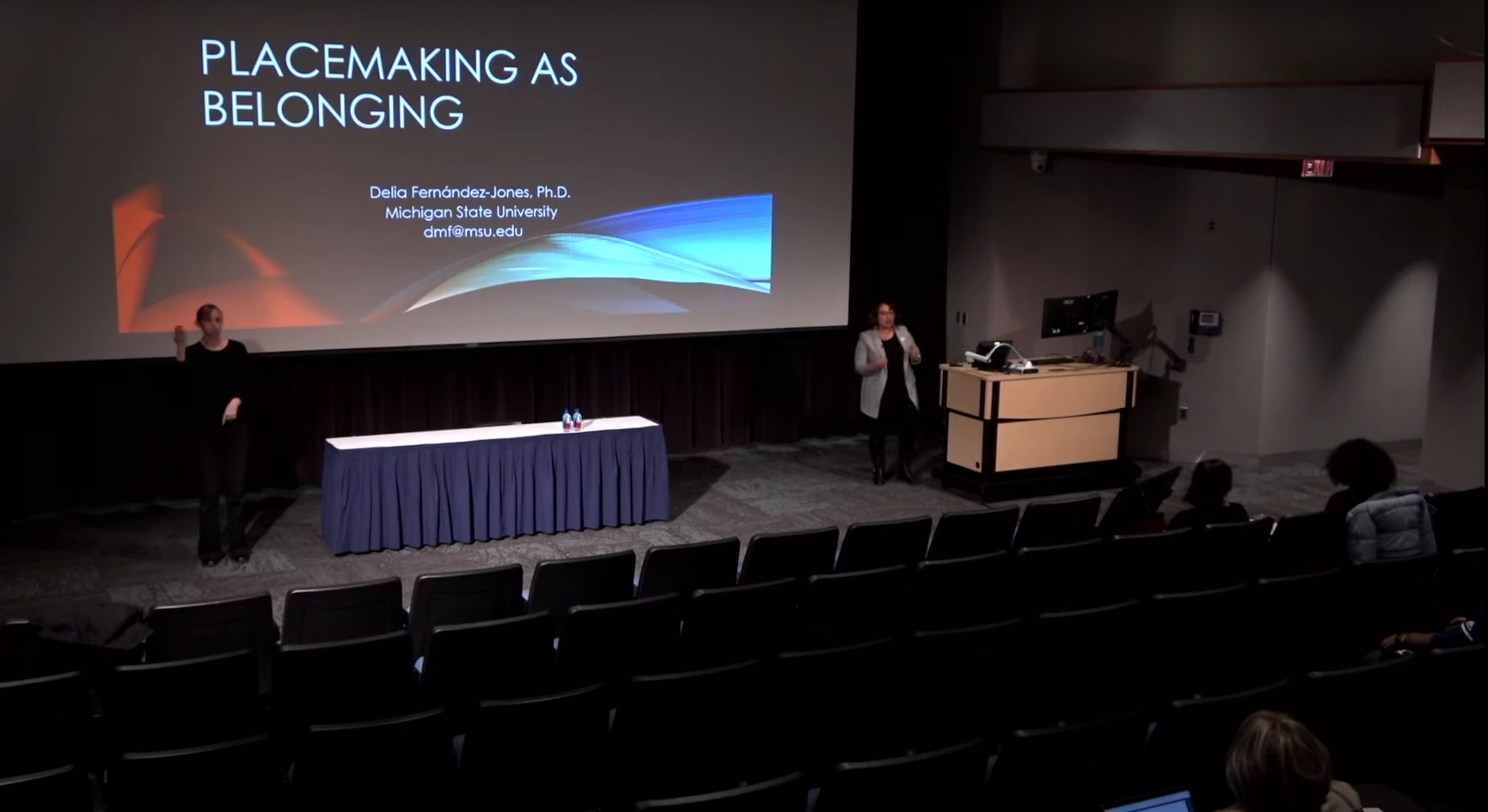
On Thursday Nov. 9, Grand Rapids Community College’s Office of Diversity, Equity, and Inclusion hosted a Diversity Lecture featuring speaker Delia Fernández-Jones, author and associate professor of history at Michigan State University.. The lecture was titled “Placemaking As Belonging.”
The lecture began with a Land Acknowledgement Statement on the screen from the ODEI giving a quote from the United States Department of Arts and Culture: “We acknowledge and recognize that when we host activities (in virtual or in-person format), these events take place on stolen and colonized land. We recognize that “an acknowledgment by itself is a small gesture. It becomes meaningful when coupled with authentic relationships and informed action…acknowledgment is a simple way of showing respect and correcting the stories and practices that erase Indigenous people’s history and culture.”
Fernández-Jones, a first-generation GRCC college student, is a core faculty member of the Chicago/Latino Studies Program at MSU, the Director of Womxn of Color Initiatives and author of “Making the MexiRician City: Mexican and Puetro Rican Migration, Placemaking, and Activism in Grand Rapids.” She also has written two award-winning articles on Latinos in Michigan. For more information on her mission, you can visit her website, deliafernandezjones.com
Fernández-Jones began the lecture with a question that many people of color including Fernández-Jones get a lot, “But where are you Really from?” She tells those people that she is from Grand Rapids, in which people sometimes ask “There are Latinos in West Michigan!?”. Without considering how it makes her and other people of color feel to be questioned about their heritage and right to live in a particular place, some boldly press on with the question “What are you doing here!?”, which she describes this idea as “microaggressions” which means “a comment or action that subtly and often unconsciously or unintentionally expresses a prejudiced attitude toward a member of a marginalized group (such as a racial minority).” – Merriam-Webster
Fernández-Jones read a statement from the Combahee River Collective Statement of 1977, “If Black Women were free, it would mean that everyone else would have to be free since our freedom would necessitate the destruction of all the systems of oppression.”
Fernández-Jones offered some bullet points on the topic of belonging, including:
- Knowing you are welcome
- No challenges to your presence in a space/role
- Seeing yourself and people like you reflected in the leadership and policies
- Having support for the unique challenges you and people like you face
She also gave examples of Belonging as Transformative when it:
- Reshapes the narrative about who belongs where
- (Provides) a vote of confidence in marginalized peoples and their futures
- Signals a cultural shift for those who hold resources and exclude others from them
- Alters our relationship with and understanding of one another
Fernández-Jones shared a quote from student Irma Garcia Aguilar, “…our lunches might have consisted of tortillas with some leftover meat or something and rolled up in a Butternut Bread wrapper…then you would get to lunch and put (the tortilla) under the table because tortillas were not known then so everybody would look at you like ‘what are you eating?’”
Delia shared many family photos and stories about her family history and college mentor relationship that inspired her to pursue a scholarship opportunity at Grand Valley State University and continue her education to earn a Ph.D. and become a professor herself.
Fernández-Jones closed the lecture with her mission on helping women of color. She shared a quote from M. Jacqui Alexander, from Duke University who said, “We are not born women of color, we become women of color. In order to become women of color, we would need to become fluent in each others’ histories, to resist and unlearn an impulse to claim first oppression, one-of-a-kind oppression defying comparison oppression. We would have to unlearn an impulse that allows mythologies about each other to replace knowing about one another. We would need to cultivate a way of knowing in which we direct our social, cultural, psychic, and spiritually marked attention on each other. We cannot afford to cease yearning for each others’ company.”
You can watch the video Fernández-Jones’s deliver her lecture on GRCC’s YouTube channel.
GRCC’s ODEI will hold a panel discussion titled “White Washing Indigenous Cultures” on Thursday Nov. 16, from 10 a.m. to 11 a.m. in Room 168 at the Applied Technology Center. According to the website, the goal behind the panel is to “begin discussion about how Native American and Indigenous cultures are whitewashed and Americanized and to give the GRCC campus actionable ways to authenticate this narrative accurately.”