By Juliette Bolle-Leon
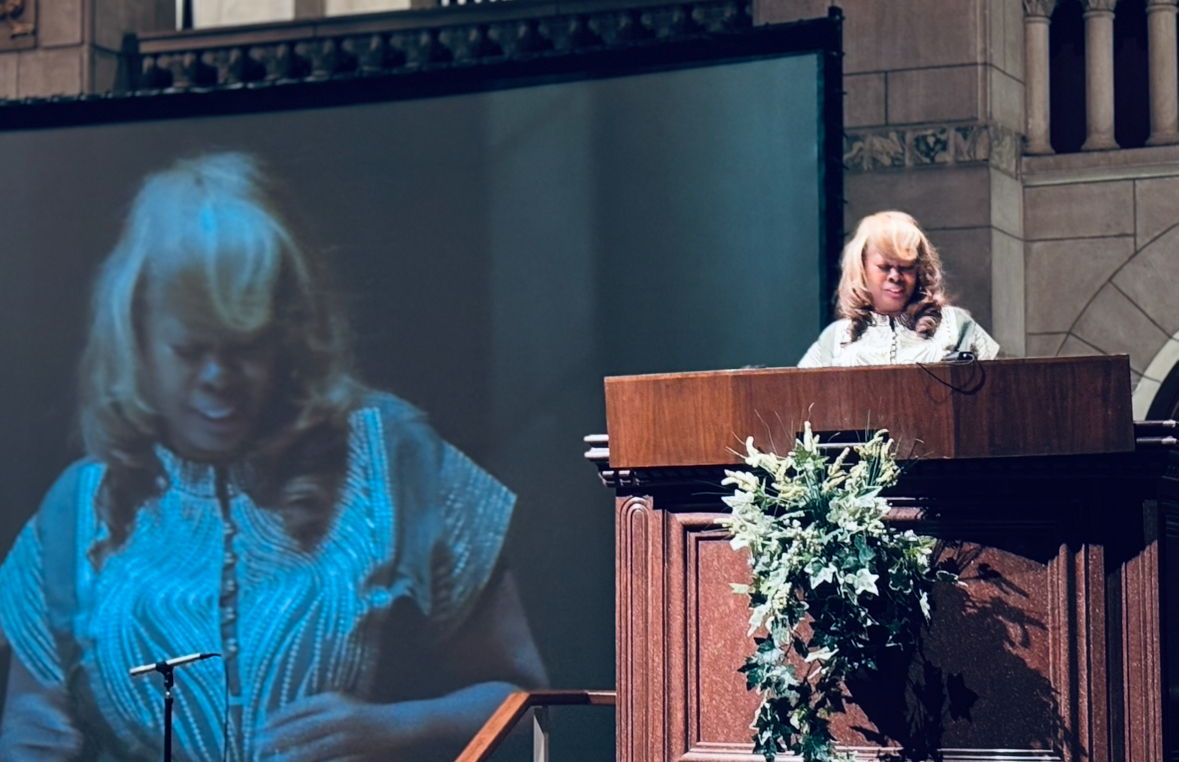
On March 26, Fountain Street Church held a commemoration in honor of Martin Luther King’s life work of establishing peace and equity among minorities, Black or otherwise.
The commemoration, which was originally scheduled for February but faced a weather delay, featured speeches from the Davenport University President Richard Pappas, DU Assistant Director of Adult Admissions Transfer Jamarcus Wiggins, Grand Valley State University President Philomena Mantella, Vice President of Division of People, Equity and Culture at GVSU Robert Shorty and Vice President for People, Culture and Equity of Grand Rapids Community College Nygil Likely. The commemoration also honored students who won the MLK Inherit the Dream Scholarship, which is offered by all three schools. GVSU has renamed the scholarship after Bobby Springer, the director of the GEAR UP program at GVSU, now naming it the Bobby J. Springer MLK Inherit the Dream Scholarship.
Speeches were also given by the winners of the scholarships. Shayna “Akanke” Haynes Heard from The Diatribe, an art activism group advocating for educational freedom and expression through the arts, and Carlos Cubia, Chief Inclusion, Equity, Diversity and Sustainability Officer for Corewell Health. The commemoration ended with a speech by Latosha Brown, the co-founder of Black Voters Matter, an organization focused on increasing power in Black communities by prioritizing voter registration and awareness.
Pappas spoke on the future of Diversity, Equity and Inclusion (DEI) at Davenport University and why diversity is vital.
“This isn’t just a Christian America, this isn’t just a straight America, and this isn’t just a male America,” Papas said. “… Diversity means that we enrich ourselves with people from different backgrounds. We enrich different ways of thinking… So diversity is a strong, positive term.”
Pappas expressed that he wants to fight for the principles Davenport stands on, ones that enforce DEI efforts despite the Trump administration’s challenges. He believes the fight for equality is far from over.
Mantella discussed honoring Martin Luther King’s legacy of equity at GVSU. She introduced Shorty, who announced the renaming of the scholarship to honor Springer, as well as the winners of the scholarships.
“It’s appropriate that why we’re here tonight – given the current climate that is full of challenge and uncertainty – that the narrative, as Dr. Pappas said, that surrounds DEI, seems to directly collide with the King legacy and all he fought for,” Mantella said.
Jerahmy Gray and Maria Ramirez-Lopez, both attendants at Grand Rapids University Preparatory Academy, won the scholarships provided by GVSU.
Likely welcomed the recipients of GRCC’s Inherit the Dream Scholarship: Valeria Caceres Suárez, a student from Nicaragua, and Avalyn Rose DeFrang, both attending Sparta High School.

“What I’m going to do after college is still a question I’m asking myself,” DeFrand said. “All I know is that I want to make a positive impact on other people’s lives and I want to make others believe in themselves and their abilities to overcome life’s obstacles.”
Wiggins introduced the recipient of Davenport’s MLK Inherit the Dream Scholarship, Kenneil Michael Tucker, who could not attend the commemoration ceremony.
A video presentation honored speakers at the commemoration ceremony from years past, with videos spanning decades of speeches.
Likely spoke on the importance of the scholarships and how education ties directly to King’s fight for civil rights.
“Let us remember Dr. King taught us that justice is not simply the absence of oppression, but the presence of equity, fairness, and opportunity for all,” Likely said. “… He reminded us that silence in the face of injustice is in itself an act of complacency. Let us not be complacent; his dream was not merely one of racial harmony, but it was a call to action.”
The commemoration displayed Warner Norcross + Judd’s 20th Annual Martin Luther King Jr. Social Justice Legacy Contest, a contest to inspire children in Grand Rapids Public Schools to create art pieces based on the work of Martin Luther King Jr. and racial injustice.
Haynes from The Diatribe emphasized the power of spoken word poetry and speaking truth to power. She recited her poetry, which tackles current politics and racial injustice.
“It wasn’t until I found poetry that I could finally unpack my fears, and what I discovered was that sticks and stones make for great poems. And a poet I know once told me that a poem could change the world…. So I asked them, and I ask you, what if it’s the one you wrote?” Haynes said
Cubia explained why he came back to Fountain Street Church to commemorate King’s work, even cancelling an event in Chicago to introduce the main speaker, Latosha Brown.
“This is the moment for us to stand up and act. The work that I do right now is not very popular,” he said. “I’m the Chief Inclusion – they don’t like that word – I’m the Chief Equity – they don’t like that word – and I’m the Chief Diversity Officer of the largest employer in Michigan. And the work that I do is under attack. … But I will not be deterred from that work. … This is not a time to say, ‘I’m going to sit back for 3-and-a-half years and then I’ll get involved’. You’ve got to get involved now.”
Cubia holds Brown and the MLK commemoration held at Fountain Street Church in high regard. He has been introducing keynote speakers for three years. He explains Brown’s background as a cultural activist. Brown is nationally recognized as a professional in Black voting rights and voter suppression and has funded over $100 million to guarantee that Black voices are heard.
Brown thanked both presidents of the universities for their courage, clarity and consistency in prioritizing equity in their schools.
“…To have leadership that has clarity, that has the courage just to do what is right, makes a difference. And to support your faculty, to support your students in this process, I know it’s hard.”
Brown held a call to action for all listeners to act despite fear. She spoke of fear of poverty, admitting that her cousin, who was buried in July, died because she was poor and could not obtain the medical attention she needed. Her lack of transportation and the hospital’s lack of care for her led to an infection spreading through her body, killing her within days.
“And I am saying this because I need us to understand that this moment is real. Yes, we are coming here- we are going to commemorate Dr. King, but part of what we’re going to do is, we’re going to be the embodiment of everything he talked about.” she said. “Are we going to build (up the love) in our community, or are we just going to talk about it in programs?”
She emphasized that the focus was not on political parties. She only believes that every human being deserves a quality life.
“I want to use my time, I’m going to use my talent, I’m going to use my treasure. I am going to do everything in my… ability to help lift up those that need to be lifted. And the truth of the matter is, everybody in this nation needs to be lifted right now,” Brown said.
Brown discussed loving everyone, even those who push their hatred onto others. Acting for the betterment of the future, even if it hurts, ultimately creates adults who make good choices and succeed.
“It doesn’t feel good to actually have to speak truth to power when you know you’ll get punished, or your institution will get punished. It doesn’t feel good that you’ve got to protect the ones that you love, even sometimes from themselves. But it’s the right thing to do and it’s necessary, and it’s what love does. … When you don’t have anything else, you can pull from love.”
Brown also touched on civil rights and the usage of the term “alien” for an undocumented immigrant. Her speech was a call to action for every minority group in the nation to fight and to love. She discussed Harriet Tubman’s freeing of slaves by following the north star and to be the north star, the guide to freedom and expression, for those the audience loves.
“And so in this moment, we don’t need a speech, you don’t need a speech. And at this moment, you need a reminder. You need to be reminded of who you are and how you can be,” Brown said.
After the event, Haynes shared the importance of honoring Dr. King’s legacy. She believes Fountain Street Church is the perfect place to remind the community of his message and life’s work.
“I think it’s less about honoring his death than it is about honoring his life, right?” Haynes said. “… Understanding more so his legacy, his life, his relentless pursuit of his work and his mission, which was to establish equality and freedom and justice… I think that there is no better place than Fountain Street Church for this type of work and for these conversations because of just that. They speak to everyone. There is not a single type of person that’s not allowed to walk through these doors….”
Haynes also believes that the schools at this event represent their principles well. She believes that silently supporting DEI will only create toleration, even with federal resources constricting many universities’ rights to freedom of speech.
“I think these three institutions in particular are obviously committed to the work. Obviously, I don’t know exactly what the nitty gritty of that looks like behind closed doors, nobody that’s doing the work is doing it perfectly, … so I think we are fortunate to have institutions like them in our community that are willing to hold space for these conversations, willing to get up there and tell us about their commitment,” she said.
Dismissing the power of a voice leads to injustice. King taught Black Americans not to fear discrimination and oppression. He not only led Black Americans to act against being brutally attacked by policemen and their neighbors but to do so in a peaceful manner.
The 39th Annual Dr. Martin Luther King Jr. Commemoration was live-streamed and can be watched in full online.