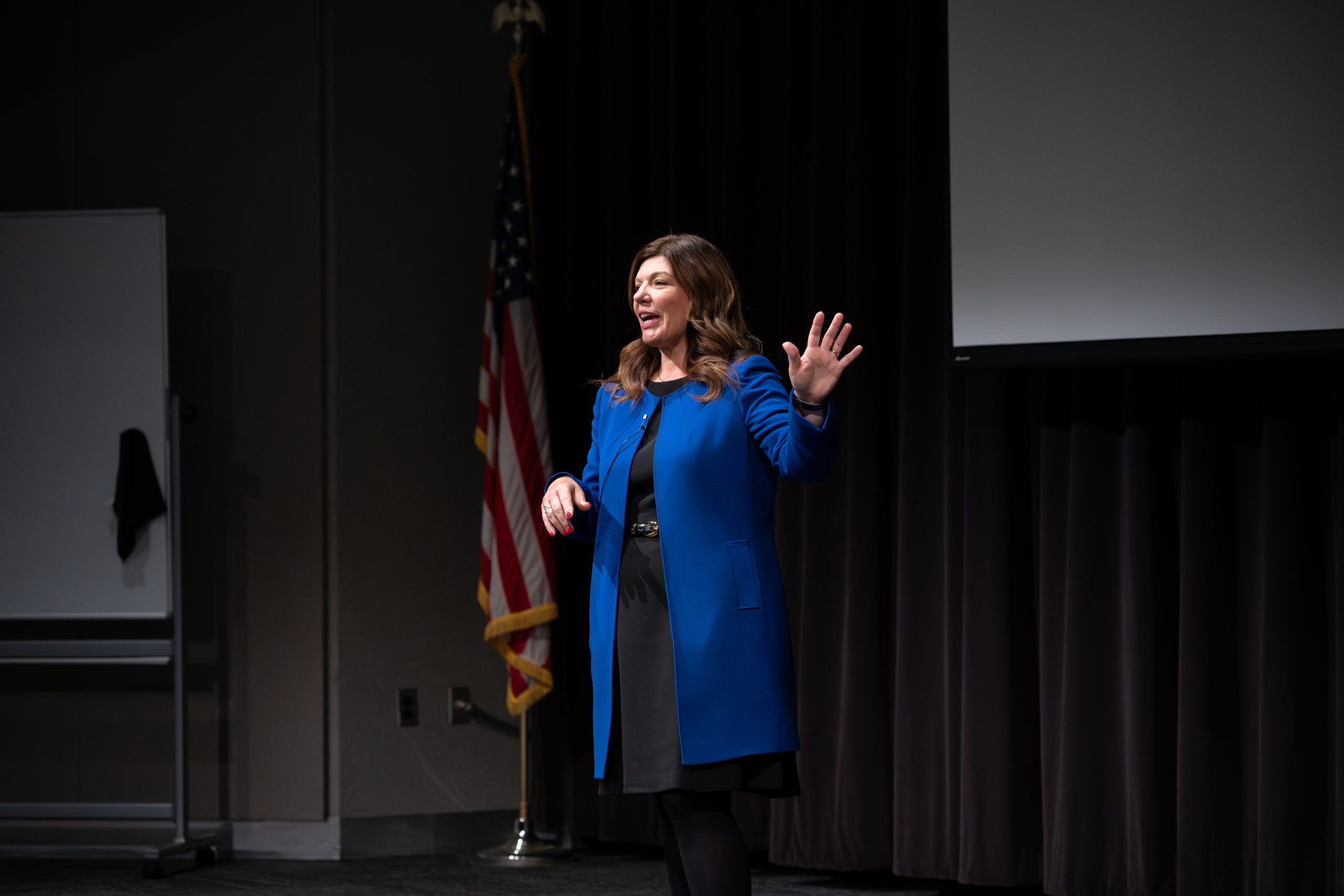
Grand Rapids Community College presidential candidate Kathryn Rogalski visited campus today for the first time. Rogalski who currently serves as Vice President of Academic Affairs and Workforce Development at Northeast Wisconsin Technical College, highlighted meeting student needs, fostering a community of belonging, and development for workforce readiness during her interview sessions with faculty, staff, and students.
The Collegiate covered the students leaders Q&A, and the faculty session that was held before.
President of Student Government Eldin Causevic began the student session.
What kind of experiences do you have that makes you stand out?
“I think that what makes me stand out as a presidential candidate here at GRCC is the experiences that I’ve had at both comprehensive technical, and comprehensive community college that are very similar. Focusing on the arts, theater, music, athletics, and a really strong curriculum in both transfer and workforce programs. I also have experience working at a technical college where our work has been focused on making sure that students have really strong pathways into industries. So I’ve worked really closely with workforce and industry partners to make sure that the classes that you’re taking in the curriculum are meeting the needs so that when you graduate, you’re the graduates that the hospitals, the fire departments, the schools all need, and that you have the skills to come in and be successful. So taking those things together and really the last two institutions that I’ve worked at are very high performing institutions. Meaning that we have worked to create opportunities for students to be successful and to meet those expectations, bringing those experiences here I will help students ability to be successful in their courses, stay in college, graduate, and transfer or join the workforce.”
Are you willing to engage with students at student-led events?
“I love hearing from students, and not just at student events. When I get to any student event whether it’s our Phi Theta Kappa, or our Student Government, or graduations and celebrations within the classroom, I’m there. I love doing those things, I love hearing from students, I love hearing students stories, the good and what’s not going well, so I can make sure that we’re keeping an eye on that. So as president, I would welcome that opportunity, and I would also like to create more opportunities to hear from students, to be in the spaces where students can share and help guide them because we’re here to serve you.
What made you consider GRCC?
“Several factors, when I was looking and decided it was time for me to apply for a community college presidency, I wanted to come to a college that I knew was an institution that had the same level of dedication, from faculty and staff to the Board of Trustees, when it comes to student success. Every place that I go to ask about GRCC, I hear the same thing. That there’s a strong commitment, a strong culture, and excitement and a passion about the work that is happening here.”
Rogalski also responded to questions from faculty members before the student session.
If your only assignment for one week was to advocate for and highlight the value of faculty within the community, what would your week look like?
“If I were able to go out to the community and really shout from the rooftops what faculty does, the first thing I would talk about is that our faculty at community colleges work harder, and they care more than any group of people I’ve ever seen. I would start talking about the excitement and the why for why our faculty are here. I would talk about the great experiences that our faculty brings. I saw on the GRCC website about all of the credentials that our faculty here at GRCC have, and how you take what you’ve learned, whether it was from your formal education or from your work experiences, and how apply them into the classrooms where students are engaged in rigorous learning opportunities with high support from you. The community needs to know that it’s more than a job. Being a faculty member is a calling and that the faculty are here to make sure that we have students who are prepared to come in and serve communities, whether that’s as first responders, as nurses, as people who are keeping the electricity on, also as doctors, and educators.
Can you talk about a time in your current role where you directed a major change that faculty were resistant to? What did you do to help them with the change?
“When I came to NWTC years ago the president in my first week welcomed me in, and said happy you’re here, but guess what? I didn’t talk to you about this during your interview but we’ve decided to move to shorten terms and what that means is that we’re transitioning 100% of the classes that we offer from our 15-week schedule into eight weeks. And we want you to do that and we want you to lead that. As you can imagine, I had questions about what does this mean? What does this mean for student success? What does it mean for retention of information? The ability to teach some very technical classes, high rigorous classes in just eight weeks, can students be successful with that? I started with faculty, I started opening up listening sessions with faculty and in the beginning the faculty wanted me to have answers for these questions. What does this look like? What would my schedule be? What’s my workload? How’s this going to impact students? So I was very vulnerable in that space, I didn’t have the answers, but I wanted to work through this with them, I wanted us to work together. We had a great support team that would meet with each faculty team independently to map it out. The faculty needed an academic calendar to be able to see it, process it, and develop that early on. The resistance wasn’t because the faculty didn’t want to do hard work, they were genuinely concerned about the students. I give this example because it was me working closely with faculty and it was a great opportunity for me as a leader to work side by side with faculty through a complex and full-college transformation.”
The final presidential candidate Jason Rivera, who currently serves as Vice Provost for Student Success and Dean of University College at Ball State University will be on campus tomorrow, Dec. 10. Faculty forums will be at GRCC Wisner-Bottrall Applied Technology Center in ATC 168 from 3 p.m. – 3:50 p.m. Followed by the student leaders session in ATC 118 from 4 p.m. – 4:50 p.m.