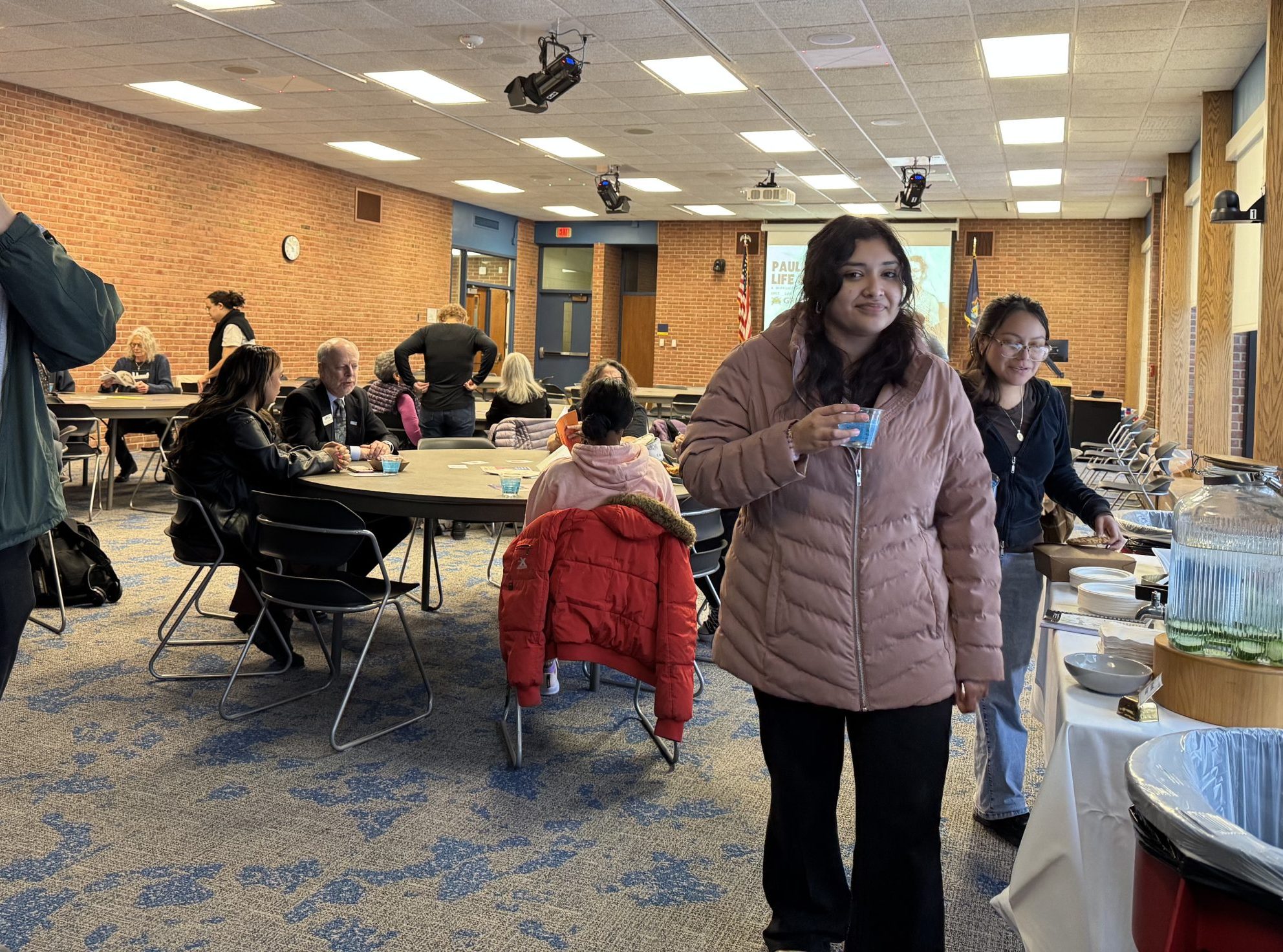
In a room full of strangers, sometimes it can be intimidating to speak up, much less read aloud poetry written less than 10 minutes prior. At the Spoken Word event, hosted by the Woodrick Center for Inclusion and Multicultural Affairs in partnership with Transfer Bridges, participants were not only encouraged to share their written works but to speak their minds.
Additionally, the Diatribe, a local nonprofit that works with Grand Rapids Public Schools to expose students to spoken word poetry, led the presentation and discussion of Pauli Murray.
Derek Welch, a lead artist for the Diatribe, further explained how the organization works to expose spoken word to a wider audience.
Welch shared how the Diatribe takes over the English credit at schools for about 10 months.
“A lot of the time that looks like taking examples of people like Pauli Murray, people like Rudy Francisco, Andrea Gibson. I’m throwing in Shel Silverstein…” Welch said.
Welch discussed how young adults may often feel they must keep their thoughts and opinions shelved, to stay silent and obedient. The Diatribe wants to break that preconceived notion and to allow for free expression.
“And letting the kids experience what happens when you have someone who can articulate their inside world clearly and just the magic of that,” Welch said. “And watching these kids become empowered enough to say how they see themselves and how they see their world.”
Welch then shared a video that briefed the relatively unknown life of Pauli Murray. The video recounts the genius and struggle of a person who knew that important work for marginalized groups was far from being complete.
From racism to sexism, and then later on researching gender and identity, Murray was someone who was not only an activist but an attorney, a poet and an essayist.
“This is a person who lived in a world that consistently said, ‘you’re not in this room,’ whether it was for her skin, the gender she was born with, or the way that she expressed and understood herself, she continuously had people say ‘that’s not what’s welcome here,’” Welch said.
After the video Welch read two of Murray’s works including her “Dark Testament” poem, verse eleven, and “Song of the Highway.” After reading each work he would then provide prompts on the presentation, but opened up the floor to whoever wanted to share their thoughts. The purpose of the format would then allow the audience to be able to engage in meaningful conversation rather than just idly listen to a presentation.
In reference to a question that asked if Murray’s poem was still relevant and or timely, Welch said, “I think that’s something cool about a good poem… that it can touch a piece of humanity that has longer implications. If you can say something succinctly that is complicated and lasts decades or centuries… it will resonate with anyone on a timeline who’s feeling that.”
After reading and discussing the two poems, participants were provided with more writing prompts and were welcome to jot down some of their own thoughts, poetic or not. Welch then asked people to share their work out loud, if they felt comfortable, and shared a poem of his own to encourage others to do the same.
A crowd favorite was from Janice Sclaza, a member of the Grand Rapids Women’s Chorus, who wrote about a frustrating moment at Home Depot, which garnered laughs from everyone. In her writing she emphasized a broken blind, swearing in front of kids, and one crazy old woman.
A few students were also willing to share how they ended up at the event.
Sophia Marin, 23, of Wyoming, and student employee of the Woodrick Center for Inclusion and Multicultural Affairs, shared she had helped out with previous events.
“I helped with their last workshop. I think it was also focused on Pauli Murray, so I wanted to make sure I came back again to the next workshop,” Marin said, who was accompanied by two friends.
Madison Solis, 20, of Holland, shared, “I met someone yesterday, and I asked them ‘how do I get more involved?’ They pushed this event, and I was like ‘okay.’”
Marin shared her own experience with poetry and explained how she prefers to utilize it in a more therapeutic and cathartic way.
“It’s not like something that I share or post around, but, like, when I have thoughts, I’ll, you know, jot them down. And this workshop really helped flow for me, also… poetry doesn’t always have to be serious,” Marin said. “It has to just evoke an emotion. And I feel like that’s something that I kind of forgot and it kind of helped me get back in the swing of things.”
Although Marin had previous experience with writing poetry and enjoys doing so, Solis shared she’d rather read it.
“I do not (write poetry), but I really like reading it,” Solis said. “I definitely need to come to more events.”
Once concluding the event, Welch shared more events from the Diatribe, and Scalza shared future dates for the Grand Rapids Women’s chorus.