By Neveah Morofsky
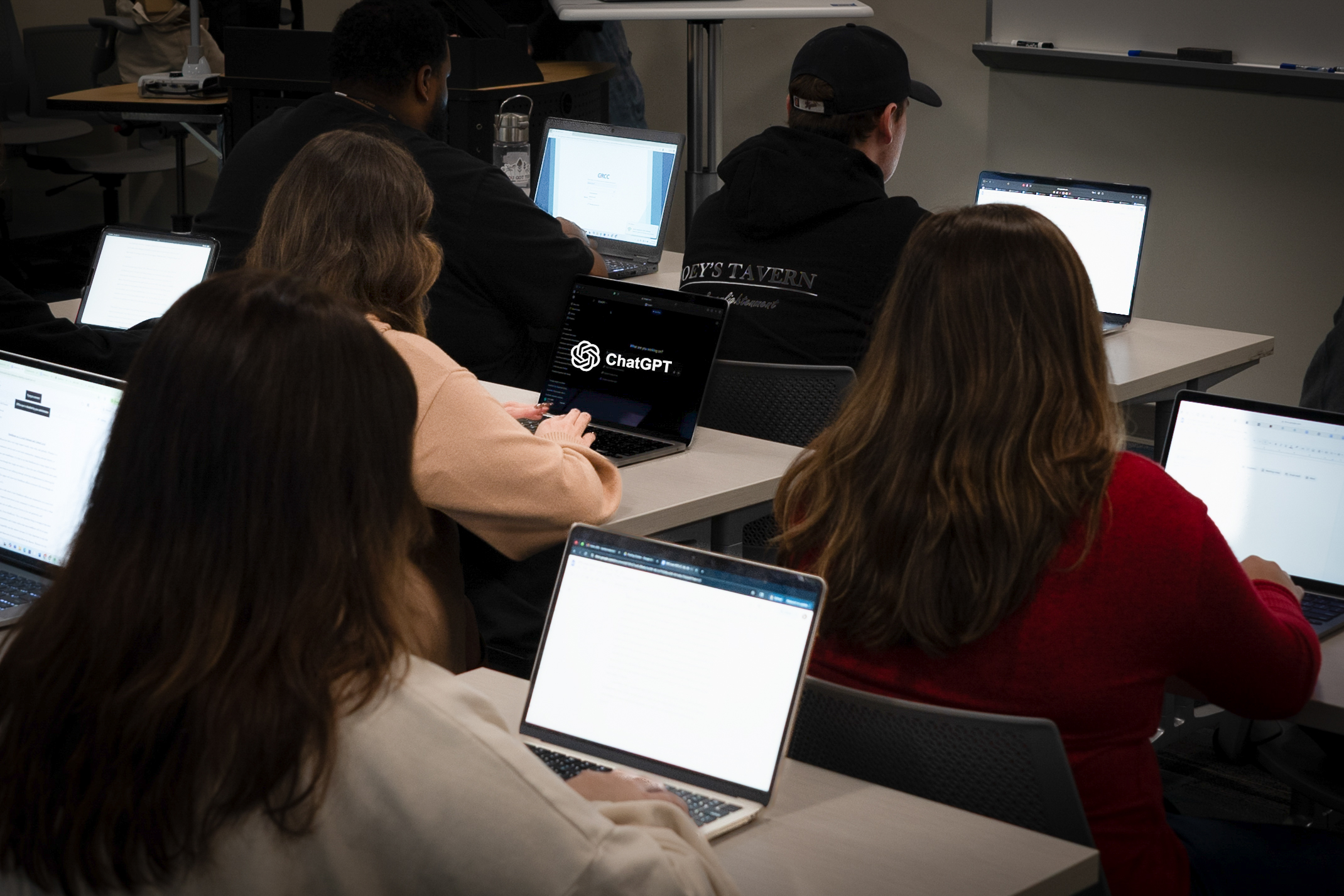
With the increase in popularity and accessibility when it comes to artificial intelligence, a growing concern has been the utilization of certain generative tools on college campuses.
While there is no strict campus-wide rule on whether or not the use of AI in Grand Rapids Community College classrooms is prohibited by students or staff, professors have been given the freedom to put their own rules into place, depending on the course.
Professor Megan Coakley, the Head of the English Department and professor of American Literature here at GRCC, has offered her stance on the use of AI by students, as someone who does not allow it in the classroom.
“The way I view learning is that it is an internal experience,” she said. “… My students… realizing that their thoughts and experiences and observations matter is more important to me than a paper being generated.”
Coakley explained how students tend to associate their academic progress with the merit of their thoughts, and how, oftentimes, students will resort to AI use out of fear of a bad grade.
“They tie the grade to their thoughts and observations, and there’s a lack of confidence… so, this robot will do it for me better.”
As the Head of the English Department, Coakley believes that the use of AI should remain up to the professors rather than departments or the campus as a whole, in order to not infringe upon any one faculty member’s preferences.
Sheila Jones, the Provost and Executive Vice President of Academic and Student Affairs, shares this same sentiment.
“With our college-wide policy-making, if there’s a ‘department policy,’ they might’ve all agreed as a department in their discipline to have common syllabus language,” Dr. Jones explained.
AI utilization certainly isn’t new for college campuses, but the uptick in popularity over recent years regarding generative tools such as Copilot, Gemini, or ChatGPT brings the need for regulation. As described by Kristi Haik, the Dean of Science, Technology, Engineering, and Mathematics (STEM), GRCC is a Google campus, meaning the tool of choice for staff is, more often than not, Google Gemini.
“It is, cybersecurity wise, more safe and more cost effective for the college to use Gemini instead of ChatGPT, or Copilot, or Claude,” Haik said.
She goes on to explain how she encourages her staff to find safe ways to integrate Gemini into their jobs to handle mundane tasks such as organizing schedules. Dr. Haik details how she uses Gemini for scheduling, as well as enhancing clarity and determining a more cohesive tone in regard to emails.
Along with many other resources, Haik provided a copy of an email sent out on Sept. 15 2025 to faculty members regarding the use of Gemini on campus. The email states that “… Google Gemini is already included in our existing Google services at no additional cost.”
The email then lists a handful of reasons why using something like Gemini over ChatGPT, stating that it will “maximize resources, stay integrated, (and) protect security and privacy—keeping our information within GRCC’s trusted Google environment.”
The message goes on to explain how AI should be used as a tool rather than the heavy-lifter, and that faculty shouldn’t simply “copy and paste what AI provides—apply your expertise, judgement, and context to shape the final product.”
Along with faculty members being allowed to use Gemini for their work and having the freedom to allow students to use AI in their classrooms, the college opened what is known as the AI Incubator in June of 2024.
The AI Incubator is a space where students, staff, and even local business leaders can learn about the progression of artificial intelligence and how to harness those developments for their own careers.
Jonnathan Resendiz, Assistant Professor at the Computer Information Systems Department and the Faculty Director of the AI Incubator, stated in an email to The Collegiate that “(T)he AI Incubator at GRCC exists to democratize access to artificial intelligence… We want to make AI accessible, practical, and aligned with workforce needs for our students and for the broader West Michigan community.”
He explains that the end goal of the AI Incubator is to help students and other community members be familiar and comfortable with AI in the workplace, so they are better equipped to handle changes and progressions in technology.
When asked if there were any potential negatives of the Incubator, he said that “(T)he greater risk would be ignoring AI. Avoiding it does not prepare students or our workforce for what is already happening.”