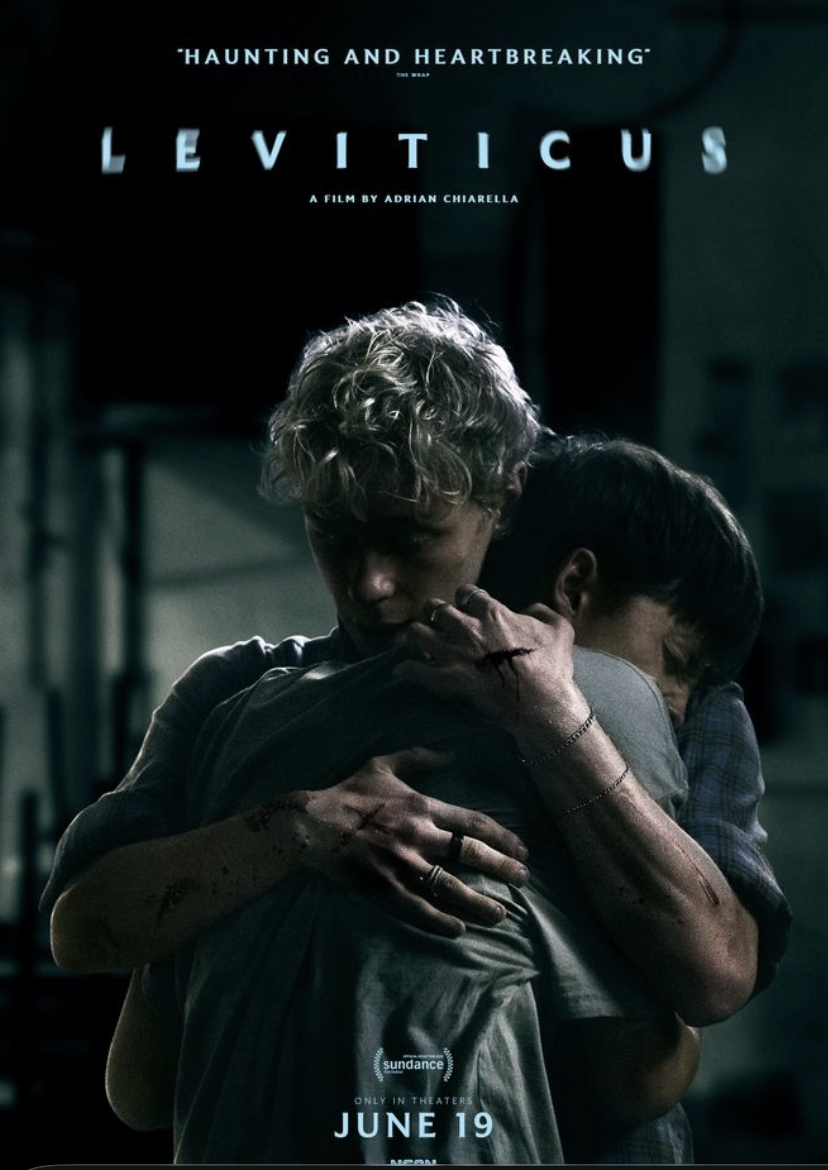
When I walked out of the movie theater after watching “Leviticus,” the main takeaway I had was that homophobia doesn’t make anyone less gay. I also immediately downloaded the Letterboxd app and left a 2/5 star rating. I’d like to preface that before sitting down with my overpriced Barq’s root beer and small popcorn, I knew that this movie was rated R horror and queer-friendly. That was it.
I soon found out that the June 19 release is set in a nondescript religious town and that Naim Reid (Joe Bird), yes, pronounced like its homophone name, and his mother, Arlene Reid (Mia Wasikowska), have recently moved in after the death of his father. While his mother takes comfort in the small and supportive environment of the church, Naim is not so easy to please and is unsettled by the too-small town, but is able to find solace, as well as a secret romance, with Ryan Whelan (Stacy Clausen), a local boy.
Although I am not new to contemporary religion intertwined with horror, I did not find myself stressed or even startled one bit. During a ritual that can be a nod to conversion therapy, performed on Naim, Ryan, and another boy, Hunter (Jeremy Blewitt), the movie’s namesake seemed a little too on the nose as the “Deliverance Healer” (Nicholas Hope) seemingly quotes from Leviticus, the third book of the Torah, and from the Old Testament, the first half of the Bible. But other than a little fire with fire play, the religious aspect relied a little too heavily on the assumed persecution of the queer community by organized religion.
The horror itself takes place in the form of an “entity” that targets each of its victims when alone with the goal of eventually killing them. After talking to another victim, Jessica (Shannon Berry), who is affected by the same curse, the boys realize the entity is customizable to each person, or rather, whoever the victim desires or is most drawn to, for the rest of their lives. Thus, Naim sees Ryan and vice versa, but it’s noted that the form of their stalking entity can change. In addition to the entity, there was certainly gore, but it was just fine.
My rating might be misleading, since the movie wasn’t necessarily bad, but it also wasn’t good, and there were a few problematic moments. For example, there is a sex scene that feels too experienced and adult for two supposedly high school-aged teenagers; in addition, it took place in the back of a very public bus. Completely inappropriate. While I do acknowledge that some teens are having sex, and it would be foolish to assume otherwise, I think that sensitive scenes that involve intimacy should be portrayed as accurately as possible. And I highly doubt that sex for most teens is glamorous or, say, exciting, such as the scene shown in the movie.
Sex aside, since the scene was not revolutionary, it did nothing for the plot of the movie, and if removed, would not have changed the ending. It was thus completely unnecessary and makes me question the producers and directors’ own motives and intent.
Similar to the bus scene, it felt like things just happened, and the character’s motives were lacking. I found it difficult to stay convinced or compelled by the actions of the characters, who were flat and static. And now that I think about it, I didn’t feel bonded or attached to any of the characters; they were that undeveloped.
I guess neither Naim nor Ryan were super attached to other characters either, though, besides themselves, as they seemingly are able to move on quickly after running over, and supposedly killing Izzie (Davida Mackenzie), the pastor’s daughter, after almost getting hate crime-d by a gang of teen boys. Like what in the world? I feel like experiencing just one of those events would be enough to cause lifelong trauma.
While receiving a 6.8/10 on IMDb and a 92% on the Tomatometer, Letterboxd was the closest to my personal score with an okay rating of 3.8/5. Maybe I’m missing something. But to get back to my main takeaway, the religious ritual performed on Naim and Ryan was definitely a metaphor for conversion therapy, and despite its best efforts, ultimately did not work. Rather than fearing for the rest of their lives and giving into the conversion ritual, the boys accept their fate. They resolve to die on that hill… perhaps literally.
The film even hints at the possibility of a lavender marriage as noted by Hunter, who shared that the conversion “worked” on one person who ended up married with a wife and kids. I highly doubt this, though, and I believe that what Hunter may not have understood is that, rather than the conversion working, the person merely resolved to marry someone who fit the mold, instead of living a life in constant fear. Because if a person desires what they are supposed to want, then there cannot be an entity. A person might have a wife or even kids, but that doesn’t make them less gay; it just makes them more palatable to the homophobic individual.
“Leviticus” is in theaters now, click here for showtimes and tickets.