Mentally disabled.
What do those words mean to you?
Maybe you think of versions of it with ADHD, autism, or bipolar disorder. Maybe you think about what you’ve heard in the news, from your parents, or from other peers.
I can say from my own struggles that the stigma surrounding mental health impacts those with said “problems” more than most people see. Everything from elementary school bullying to the value of self-worth, even the idea of our minds being “sick,” gets internalized and majorly impacts our well-being, particularly in schooling.
According to findings from a recent study, 57% of student participants at Grand Rapids Community College have reported that they need help regarding mental health concerns, most of which are clinically significant. Despite GRCC offering resources to help, only 13% of participants stated that they use them.
With these findings, it was clear that something had to give one way or another. If people aren’t using the resources, there isn’t much the school can do to help.
That was until FLOURISH.
FLOURISH is a peer-led student outreach group designed to support students’ ideas of personal success and self-actualization through its four R’s: Rooted, Reaching Out, Resilient, and Radiating.
Rooted: Rooted aims to assist with aspects like time management and budgeting, helping students to become more well-rounded.
Reaching Out: Reaching Out aims to combat isolation and loneliness with accessible, peer-guided programs.
Resilient: Resilient focuses on equipping students to recognize and handle hardships, both their own and others, with skills-based training, education, and mental health literacy.
Radiating: Radiating builds relationships that radiate outwards, creating major change with peer mentors and role models.
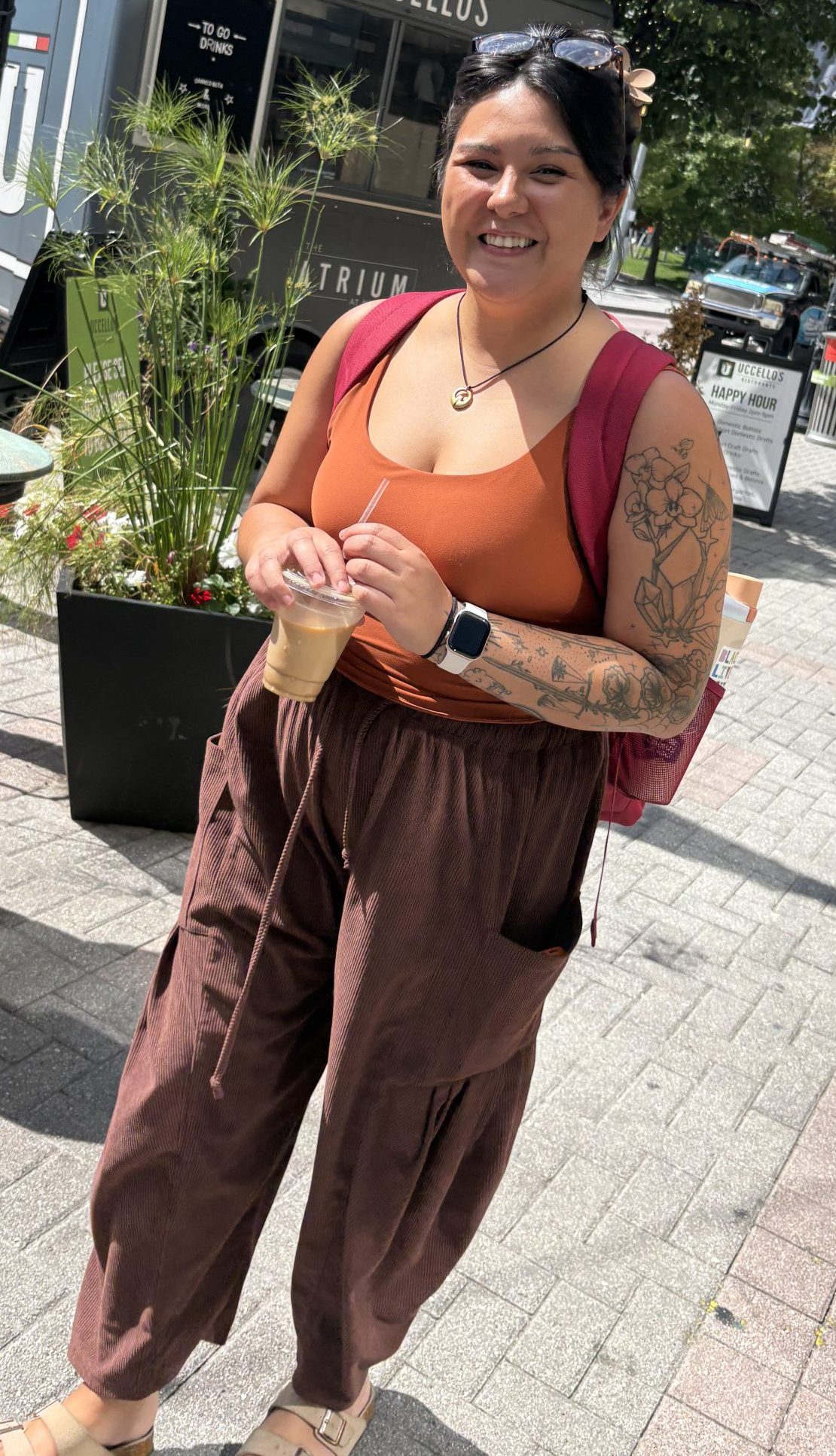
Who is the human spark behind this initiative? That would be the energetic and bubbly Toni Keniston.
Keniston, 37, from Mattawan, is a second-year GRCC student, loving mother, illustrator, and someone who actively tries to understand those around her, believing in her personal rule of “there’s always more room around Mama.”
“I’ve been using the word floundering a lot lately, from floundering to flourishing. I came from a very disadvantaged childhood, so a lot of abuse and neglect, and it also fed into a lot of my mental health conditions. I graduated, and I had a lot of anxiety. I had generalized anxiety disorder, ADHD, CPTST, so all of those things that I wasn’t really aware were under the surface or really impacting my ability to go to school. I just couldn’t even pay bills, so I dropped out, and I don’t really think that I finished a full semester, maybe one class,” Keniston said.
As we talked, she described how during her first semester, she was nominated by a professor for the honors program at GRCC. Through the program, Keniston was able to meet with Melissa Ware, Program director for the Center for Counseling and Well-being at GRCC, and over the summer collaborated with her to study student data in terms of mental wellness and whether they felt like they were “flourishing” at GRCC.
The work paid off in the end, and FLOURISH was born.
In her own words, people with mental disorders are the “canaries in the coal mines.” When they are failing, everyone is failing.
“It took 19 years for me of learning about my neurodivergence, which really didn’t come into play until I was about 30,” Keniston reflected. “That’s when I got diagnosed with ADHD, and that’s when I found out I was on the spectrum and all of these other things that were impacting me, and then I went (on a) really big journey to accommodate myself. By understanding myself better, I could better set myself up for success.”
As she spoke on her experiences, Keniston also expressed her current concerns and plans with colonialism in mental health and the stigmas toward mental health that it brings.
“Part of my scholarship and what I focus on is decolonising work. And part of that is community care, because a lot of what happened was that as colonialism overtook all of our communities, we stopped taking care of each other,” Keniston explained.
Keniston said that she has created a proposal for a panel at The Woodrick Center at GRCC to talk on decolonising wellness.
“The main focus would be decolonising wellness. A lot of mental health is now pathologized, ‘you’re ill,’ Keniston said.
According to Keniston, in the past, the remains of indigenous people with mental health issues were found living to an old age, showing signs of communal caring being a common practice. She also touched on gender norms and knowledge gaps being impacted, referencing housewives helping to give birth and how that knowledge is now behind a paywall.
“Decolonizing is removing that barrier and understanding that the other ways of doing things are just as valid. It’s returning to Indigenous practices. Restoring the way we used to do things,” Keniston explained. “I’ve developed kind of my own framework, … so there’s two sides to it. The first one is you decolonize, deconstruct, and dismantle. Decolonize from oppressive mindsets, deconstruct (harmful) ideologies, and dismantle harmful systems. And that’s a lot of the decolonizing talk. People want to talk about that. But where I’m more interested is this other half of it, of restoring, recovering, and reimagining.”
Keniston continued by questioning what would fill in after decolonization. For her, she feels that it should be a system designed around those affected, improving on what came before.
In a similar vein, Keniston briefly talked about her experiences as a mother of 2 and how it’s changed her as a person, explaining that they are a large reason that she is pushing for change.
Keniston stated, “For me, the mother that came out of me was no longer so self-interested, but really wanting to make sure that the community that I’m releasing my kids into (is better), because I can (only) do so much for them, I have to also make impacts to where they’re going to be in, you know?”
“I think of it like the dead fish theory, where if a bunch of dead fish wash up on the shore, you don’t say, ‘what’s wrong with that fish,’ you say, ‘what’s wrong with the water?’ Something’s happening,” Keniston continued. “So that’s where I was like, I want to go upstream, and I want to create change that was going to benefit my kids.”
FLOURISH is designed to be a space free from all the barriers of colonization, where people can thrive differently. According to Keniston, she wanted it to be a place where there are no rules about what you can and can’t accomplish, and no way of getting it wrong.
“It’s really hard to be a zebra if you think you’re a broken horse,” Keniston said. “The moment that you find out you’re a zebra, you can find community with other zebras. You don’t feel like you’re failing at being a horse.”
Currently, Keniston and her peers are working on a proposal to submit the idea of FLOURISH to the National Association of Higher Education at an upcoming conference in Austin, TX, in January.
“I think it is such a dream of mine to see it expand, and I really hope that it will,” Keniston said.
The first event that FLOURISH is hosting is a body dubbing study session this Tuesday, Sept. 1, from 1:30 p.m. to 3 p.m. The event is open to everyone.