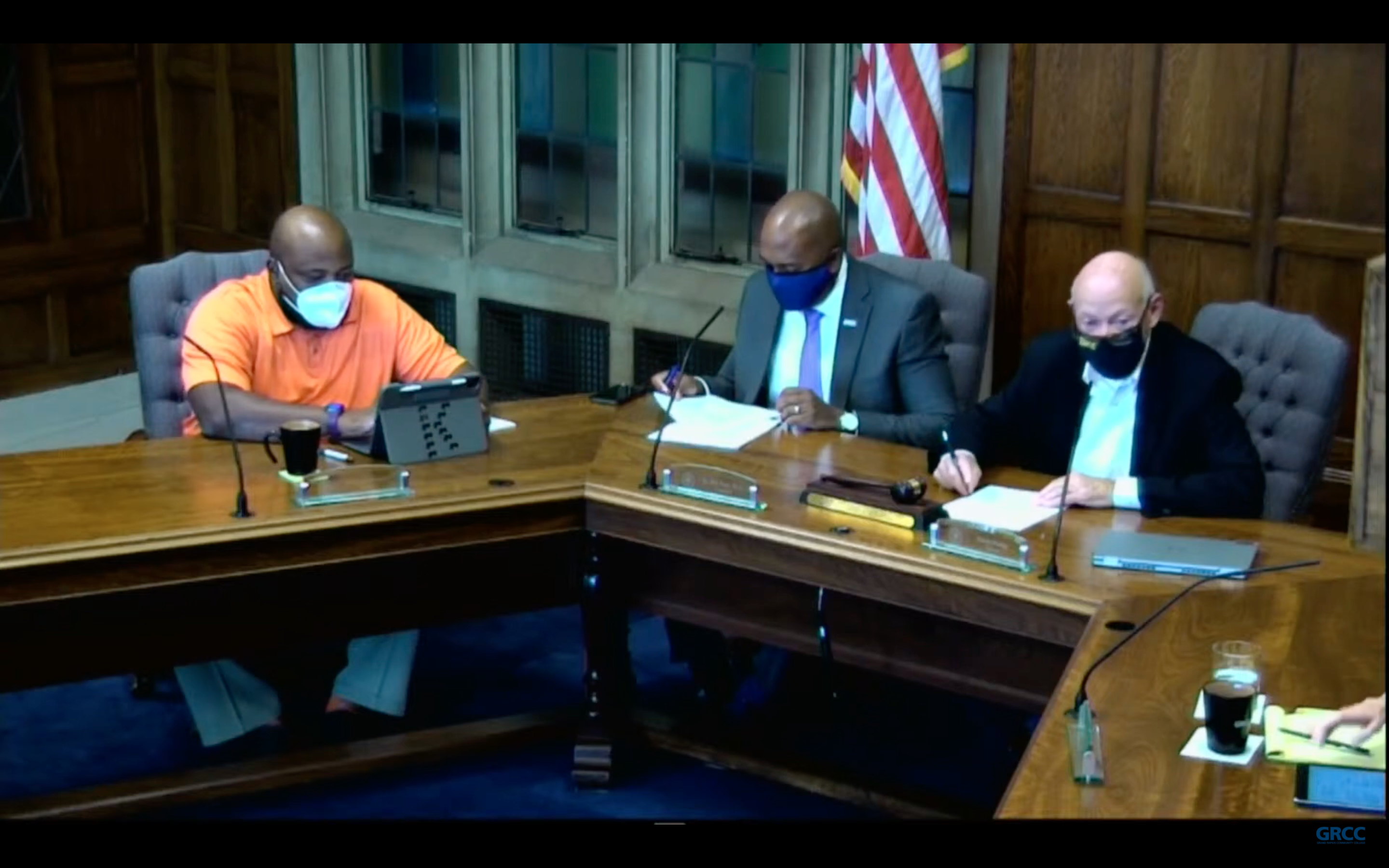
The Grand Rapids Community College Board of Trustees gathered Monday, Oct. 19 to approve the motion for GRCC employees to receive a stipend and discussed the state budget issuance.
Monday’s meeting also consisted of a report regarding teaching and learning plans, the school’s financial update and the 2020-21 audit report, an update from President Bill Pink and a brief note from Student Alliance that the organization’s annual budget was approved in a prior town hall meeting.
With an unprecedented amount of GRCC retirements and employees moving on from the college, a short-term salary savings pool has created the opportunity to give GRCC employees a one-time stipend. After an extensive speech by Pink, the board swiftly approved the stipends that will give $1,000 to all full-time employees and $500 to all part-time employees. These stipends will be part of the November pay period.
“My overall response is that the stipend is less important than the recognition,” said Faculty Association President Frank Conner. “Money is important, but a public acknowledgement of the effort made by faculty and all GRCC employees during this very difficult time is the real message from this act.”
“What this is is a way for this college to say thank you to some folks that, across this campus, have been working awfully hard,” Pink said. “And 18-20 months ago (they) were asked to change everything about how they do their work… and did a masterful job of it.”
Board of Trustees Chairperson David Koetje also weighed in, noting the GRCC administration is more than aware of how tirelessly employees have worked to continue delivering education to students during the pandemic.
“To you who call Grand Rapids Community College your employment home, hidden behind the masks of these trustees in the front is an overwhelming sense of appreciation for what you have done over the last 18 months,” Koetje said.
Vice President for Finance and Administration Lisa Freiburger gave a finance update, noting the state budget allocation was finally given to the college after months of anticipation. However, GRCC is only receiving a one-time operating increase ($221,000), which limits the amount of planning administrators can do.
“It makes it very hard for us to plan moving forward,” Freiburger said. “(Which is) a bit of a concern.”
Also, a state aid reduction that occurred during the 2020-21 academic year resulted in a make-up payment of $736,000. Essentially, the school was given the payment this year to offset the reduction that occurred during the 2020-21 academic year.
The teaching and learning presentation, led by Sheila Jones and Dillion Carr, discussed three sections of the College Action Project for the 2021-22 academic year. The first section highlights schedule and program optimization, the second relates to strengthening GRCC systems for the assessment of general education, and the third section focuses on the expansion and improvement of outcomes in online learning.
Vicki VanDenBerg, a representative from Plante Moran, led the presentation relating to the school’s audit report that compared the 2020 and 2021 academic years’ financial standings.
According to the audit, the school’s assets totaled $244.4 million in 2020. The school’s current assets for the 2021 academic year total $280.8 million. The $36.4 million jump can be credited to the renovations made on both the main and DeVos campuses that offer more amenities for students.
The audit also showed the compared operating revenues, expenses and net revenues for both years. For operating revenues, the school has seen a $1.2 million decrease in 2021 ($52.6 million) compared to 2020. Expenses have increased this academic year compared to 2020 as the GRCC community returns to the norms prior to the global shutdown: $155.6 million in 2021 compared to $139.8 million in 2020.
The net revenue has increased by $30 million in the 2021 academic year ($121.3 million) compared to the $91.3 million figure in 2020.
Pink gave his usual president’s update, mentioning the 400th career win by GRCC volleyball head coach Chip Will, the current construction for the upcoming Secchia Piazza at the Applied Technology Center and a brand new health benefits apprenticeship program that was created by GRCC in partnership with West Michigan Works! and Blue Cross Blue Shield.
The meeting concluded with the board approving both consent and action items that included the Capital Outlay Submission, which is an annually submitted (updated) five-year plan that divides a significant portion of the school’s state budget. This portion of the budget is dedicated to construction, renovation and maintenance of facilities throughout the campus.
The approval by the board will allow more resources to be allocated and made available at the Learning Resource Center for students, such as laptops, textbooks and more.
Editor’s Note: This story was updated on Thursday, Oct. 21 at 12:49 p.m. to include a comment from Faculty Association President Frank Conner.