Grand Rapids Community College’s counseling center is the most understaffed in the state, currently having only three counselors, and facing increasing demand, an overall rise in student distress, and worse counseling outcomes. Notably, reported thoughts of self-harm, and harm to others “sharply increased” over the past three years, which is the opposite of national trends.
This is according to the Counseling & Career Development Trends Report published on June 15. It was developed by GRCC’s Counseling & Career Development (CCD), which provides free mental health and career counseling services to students.
“So far in 2022-2023, for CCD clients, the increase in serious thoughts of harm to others is up over 100% from the prior year,” the report states. “Rates of serious suicidal ideation, those who seriously considered attempting suicide in the past month, spiked during 2022-2023 AY (academic year) …17.5% of CCD clients reported a previous suicide attempt. Clients who report seriously considering suicide at 42.1% so far during AY 2022-2023, well above the national average.”
Despite this, GRCC does not have a suicide prevention framework. Calling CCD leads to an automated voice message directing students to call GRCC Police or 988 for life-threatening emergencies. Links to various hotlines and Pine Rest can be found on CCD’s website. GRCC also has a Behavioral Intervention Team which anyone can refer a student, staff, or faculty member to.
However, the only on-campus resource for students is CCD itself, which appears to be buckling under the stress of only having three counselors to serve over 12,000 students.
The 31-page report has not been published online or widely shared, including with the Student Advisory Council, which works directly with CCD but is not currently active.
According to Melissa Ware, CCD Program Director, in the four months since this report was published, the only feedback she and her team have received from GRCC administrators was a request for Ware to write a proposal. This is despite there being over three pages of next steps for GRCC outlined at the end of the report, ranging from adding five full-time counselors to adopting a suicide prevention framework.
This report compiles data from CCD’s electronic health record from July 2020 to June 2023. The report only records the trends in students’ mental health who used CCD and does not survey the entire student body. It was created by Ware and Emily Nisley, who formerly worked in the counseling center.
Ware said she became more motivated to work on a report alongside Nisley after she went to a national conference for counseling center directors.
“I was listening to my colleagues across the country talk about their reports, their presentations, what they’re doing,” Ware said. “…Even if you just look at the counseling centers in the state of Michigan, they’re going to have reports. They’re going to report out on what they’re doing, and that’s often a requirement. I really wanted us to be able to do that.”
In June, CCD only had two counselors and was identified in a draft of the Mental Health in Community Colleges (MHICC) report as the least-resourced community college counseling center in Michigan. The MHICC report found that the ratio of clients to counselors at GRCC is 5,658.5 to 1, which is over 3.5 times the statewide average of 1,616 to 1 for community colleges.
As staffing at CCD declined, demand for counseling increased. The CCD report shows that the percentage of unique clients increased by 164% and the number of appointments attended increased by 110% in 2021-22 from the previous year.
CCD’s report warns that “serious consideration must be given to the staff-to-student ratio of CCD given that the data shows ‘likely consequences’ when the ratio increases beyond the upper limits.”
As stated in the report, some of these include “difficulty providing services to students experiencing increasingly more severe psychological issues,” and “(increased) liability risks to the counseling center and (college)…”
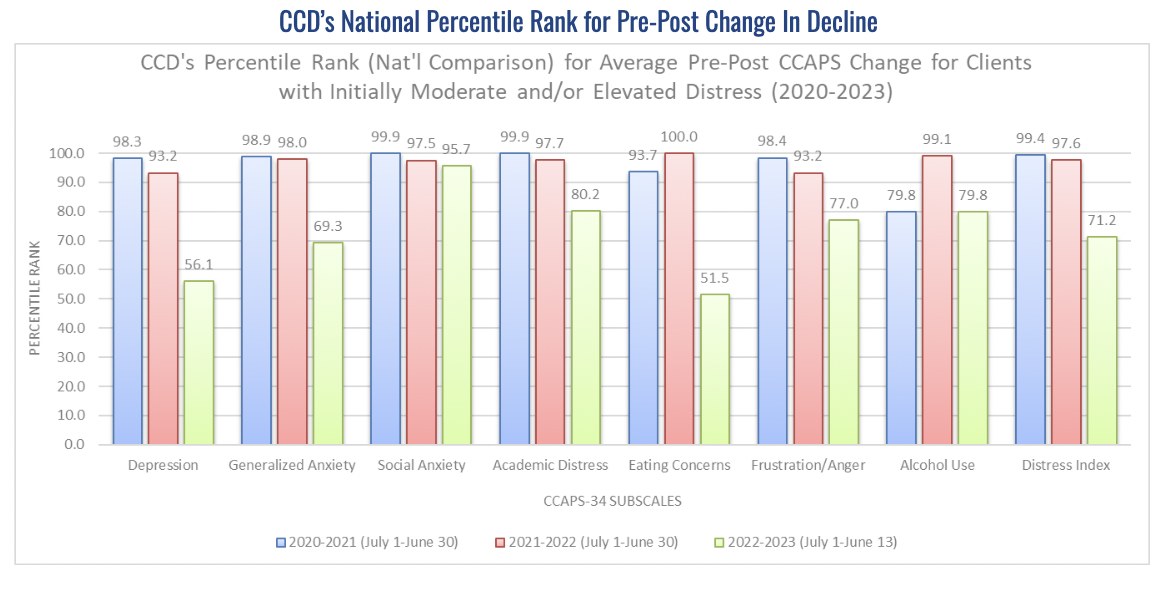
These consequences are already being felt on campus. CCD reported that it has been less effective in decreasing students’ levels of suicidal ideation and thoughts of hurting others during the 2022-23 academic year.

CCD’s national percentile rank for decreasing levels of depression, generalized anxiety, social anxiety, academic distress, eating concerns, alcohol use, frustration/anger, and overall distress index also fell this year.
A third counselor started working at CCD on Oct. 16.
“We’re so excited about Deborah Ronk,” Ware said. “She comes with a lot of experience… so blessed to have her here.”
However, Ware says this does not solve the problem of the critical CCD staff-to-client ratio. She said that CCD was overwhelmed the last time they were fully staffed. But when Emily Nisely left CCD last July, the number of counselors dropped down to two.
“It’s really Emily’s position that has been unfilled, vacant since last July,” Ware explained. “So the (counseling) position that we have is a replacement (for her) position. It’s not a new position.”
Ware, who is CCD program director as well as an assistant professor and counselor, continued, “It’s important to remember that I’m technically a half position. …I have 18 hours of director release time, that’s for administrative duties. So if you take that 40-hour week, and you cut that 18 hours, that’s 22 hours that I’d be devoting towards clinical time. So really we (have) 2.5 (counselors).”
There is also a concerning theme throughout the report that highlights the fact that GRCC’s mental health trends are significantly different than national averages. GRCC students report much higher rates of distress, past mental health/substance abuse treatment, traumatic experiences, and thoughts of self-harm and harm to others.
Ware says the CCD report is above national averages because the profile of a community college student is more diverse in age, race, and ethnicity compared to many four-year schools, and community college students typically have different responsibilities compared to other students.
“We might have a higher population of students who are outside of that 18-24 young adult age range,” Ware said. “(Community college students have) multiple responsibilities. They’re caregiving, they’ve got children themselves, they’re working jobs – which might not be the case if you take a look at a Grand Valley (student).”
The report stated that an increasing amount of its clients are “historically minoritized and first-generation students, as well as those who identify as TGNB+ and LGBTQ+ and who report being registered with Disability Support Services.”
Ware is concerned that CCD services will not improve without adequate resources from the institution.
“I can innovate all day long. I can do that,” Ware said. “I can come up with a million and one programs and projects… to meet the needs of students. But innovation without investment will only go so far.”
GET HELP: If you are experiencing a life-threatening emergency or need immediate help outside of office hours, please call 911, campus safety at (616) 234-4911, or go to the nearest emergency room. The 988 Suicide and Crisis Lifeline is available by phone, text, or chat 24 hours a day. Emergency mental health support is also available in the Grand Rapids area at Pine Rest Urgent Care.
If you or someone you know would benefit from an appointment with a counselor from CCD, free in-person or online appointments can be scheduled by calling (616) 234-4130 or by going to this website during office hours. They are open Monday – Friday 8:30 a.m. – 5 p.m. and are located on the third floor of the Student Center. Same-day urgent consultations are available at 11 a.m. and 3 p.m. every weekday.
Editor’s Note: This story was updated to clarify that the MHICC report contains statewide data, not nationwide.