
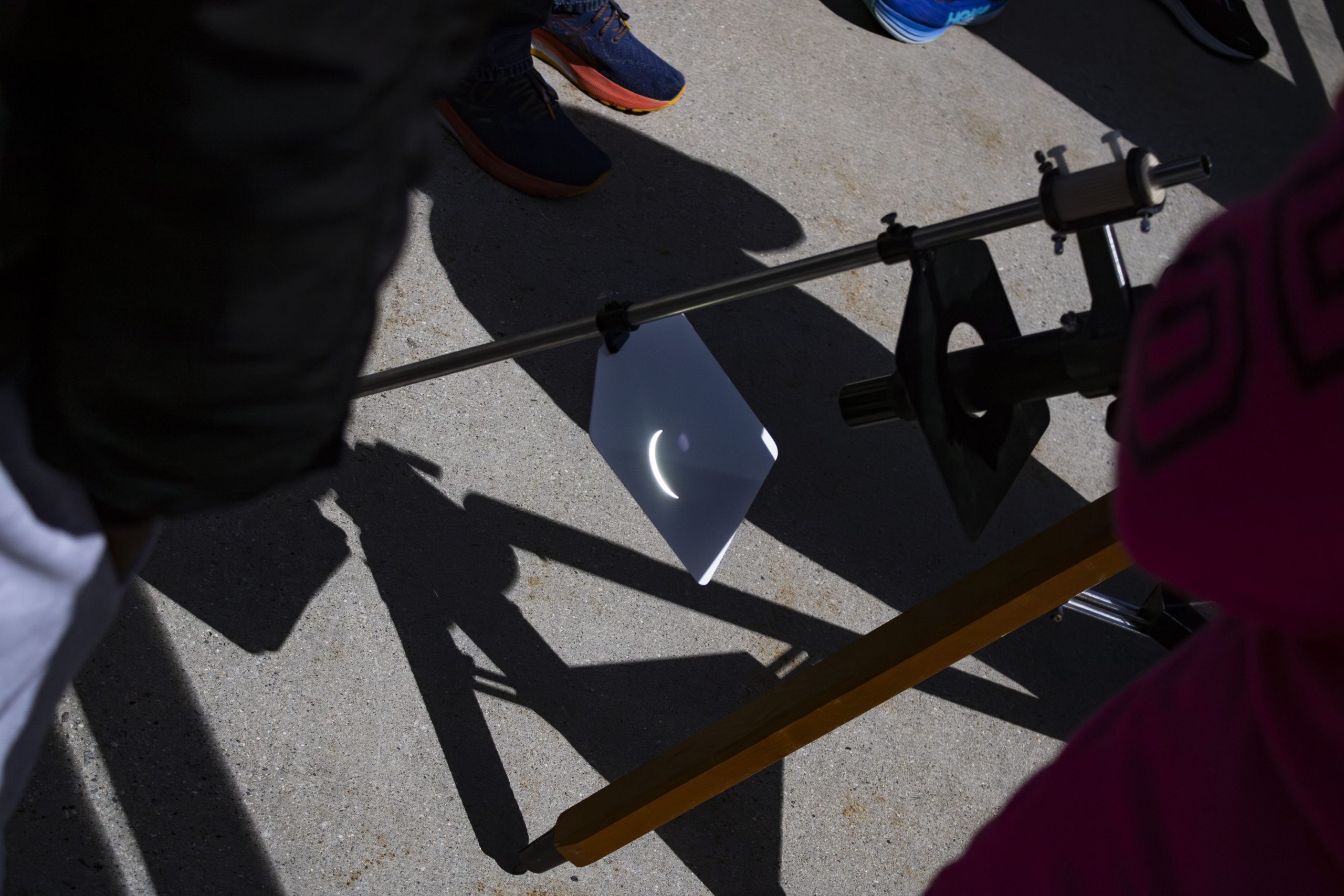
Dozens gathered on the Blue Bridge in Downtown Grand Rapids with cameras, glasses and other gadgets to witness the 2024 solar eclipse. This rare celestial phenomenon occurred around 3 p.m. on April 8, with 94% of the sun being covered by the moon.
As part of their “Total Solar Eclipse Day,” the Grand Rapids Public Museum and the WOOD TV8 Weather Team Total Solar Eclipse Day brought different solar telescopes so people could get a closer look at the moon moving in front of the sun.
Texas native Destiny Morehouse, 24, was disappointed with the solar eclipse in 2017 and stated this year’s was a lot better.
“This year I guess it brought more people together than it has,” Morehouse said. “This eclipse will probably be a memorable one… the went by too fast.”
“…We saw one a couple of years ago back but it really wasn’t anything spectacular, but this is supposed to be 93% coverage so I’m really excited,” said Eric Spindler, 21, of Palos Heights, Illinois.
Grand Rapids Community College Astronomy Professor Kyra Dame explained that an eclipse is a specific alignment of the earth, moon and sun. While the earth has its monthly alignment with a new moon, eclipses are far more infrequent.
“There’s two types of eclipses, you have solar eclipses and lunar eclipses and essentially it is a very specific alignment of sun, moon and the earth,” Dame explained. “A solar eclipse is when the moon passes directly between the earth and the sun, which doesn’t actually happen all that often. You have that general alignment every month with a new moon but the very very specific alignment where everything is perfectly inlined only happens when the moon’s orbit and our orbit around the earth perfectly line up, usually they are tilted about 5 degrees.”
The next total solar eclipse takes place in 2045 and will cover states like Florida, Mississippi, Colorado and northern California. Unfortunately, Michiganders won’t get another one until Sept. 14, 2099.