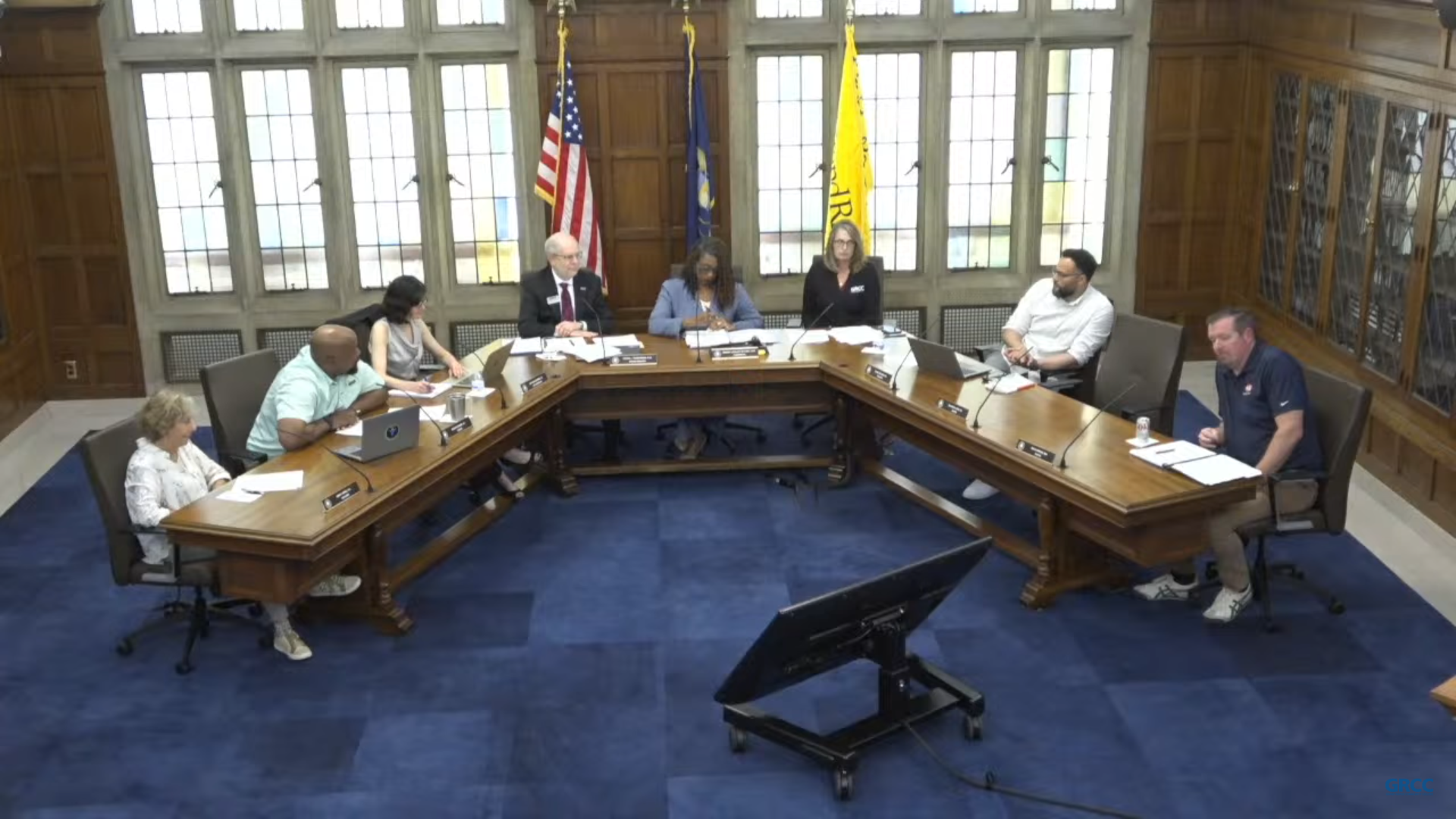
The Grand Rapids Community College Board of Trustees met for a budget work session and meeting on June 9, where year-end conclusions and the beginnings of the school’s presidential search were both highlighted.
GRCC’s new Interim President, Dr. Steven Triezenberg delivered his first president’s report, after nearly a month in the position.
After a budget work session to approve the 2025-26 budget, which remained unchanged from how it was presented at May’s work session, Board Chairperson Brandy Lovelady Mitchell began the regular meeting with an approval of Vice Chairperson Kathleen Bruinsma and Trustee Salvador Lopez to the Michigan Community College Association (MCCA) Board of Directors, which passed unanimously. The board also approved the 2025-26 Board of Trustees meeting schedule.
To match pace with a federal minimum wage increase coming in January, from $12.48 to $13.73, GRCC student employee wages will also increase starting at the beginning of the fiscal year in July, from $12.50 to $13.75. GRCC has approximately 200 student employees.
Triezenberg introduced a motion to approve executive contracts by thanking the executive team for their “warm welcome” in his first weeks in office.
“I deeply appreciate their commitment to the mission of this college and to the students, who are the reason for the mission, and also to the faculty and staff who execute on that mission,” he said.
Following that, he presented a 4% increase in executive team salary, which was approved unanimously. Last March, a 2.4% increase was approved for student tuition.
In his president’s report, Triezenberg described a “shift from ‘the new guy is here’ to ‘let’s get work done’” during his first month, echoing again his appreciation for the faculty’s support as he began the job.
The 2025-26 student enrollment goal is 12,800, and GRCC is currently at 48% of that goal. Enrollment was at 43% of that goal at this time last year. He also noted that GRCC will also be shifting its online class management from Blackboard to Canvas in the fall.
Triezenberg reiterated again that the school is monitoring the “swirling winds that affect what we do and how we do it” coming from the National Environment for Higher Education, saying that the school plans to see how some of the “dust settles” before planning a full response.
“We will not lose sight of the mission of Grand Rapids Community College, to provide open access to college education for learners coming from many different situations through many different paths, for many different goals and purposes,” he said. “Wherever we can, we will seek to take good lessons that we’ve learned from prior experiences and apply those to expand the impact for our learners.
Speaking on the “good stories” about GRCC he asks staff to share with each other, Triezenberg highlighted the golf team’s 18th place ranking at the national finals, The Collegiate winning 2024 Division 3 Newspaper of the Year at the Michigan Press Association Better Newspaper Contest, Chef Werner Absenger’s 12-week course on healthy & fast meals at the Helen DeVos Children’s Hospital and the TRIO programs that “do amazing and vital work in helping first generation students, and many others, navigate successfully into the often confusing world of higher education.”
The TRIO program is federally funded and its future remains unclear, as the federal government changes funding eligibility based on DEI programming.
Mitchell gave a brief update on the presidential search, sharing that the website will soon be launched and that the names of those on the committee will be available within the next few weeks.
The meeting was then opened to public comments, which were limited to three minutes and would not be responded to by the board.
“The chaos of the last half year has been a breeding ground for unease and uncertainty that necessitates a much higher bar for clear and consistent communication to stave off panic and rumor,” said GRCC Associate Professor of Astronomy & Physics, Lauren Woolsey. “Actions that may seem routine in a regular year can look alarmingly like anticipatory compliance to authoritarianism without clear communication.”
Woolsey highlighted the name change of policy 6.1 from Transgender and Non-Binary Equal Opportunity to 6.1 Name Change Policy— a change that, without communication, felt to Woolsey like an erasure of GRCC’s transgender members. She also highlighted her appreciation for the communication the board has delivered.
“We need to regain our footing as a community. Rebuilding trust through clear communication will be the foundation that leads to our shared success,” she concluded.
Rebecca Lovell, Assistant Professor at the Center for Counseling and Well-Being, also spoke about concerns regarding GRCC’s response to DEI changes.
“Our local uncertainty has made it harder to aid students in managing their anxiety about present realities,” she said. “We ask for GRCC’s leadership to continue to explore ways to acknowledge and name, for the campus community, the issues that we are facing as an institution, as well as those we are facing within higher ed. We also ask that leadership continue to prioritize ways to communicate to students that we care about them.”
Assistant Professor of English, Zachary Marshall, further spoke on the issue, highlighting “communication and accountability with students and staff at GRCC.” He pointed out the high number of student surveys sent out in the past year, and that many people don’t know what that feedback is being used for.
“We don’t want just raw data, but also clear, actionable next steps to improve accountability,” he said.
The board will reconvene on Monday, Aug. 18 at 4:15 p.m. in the board library.