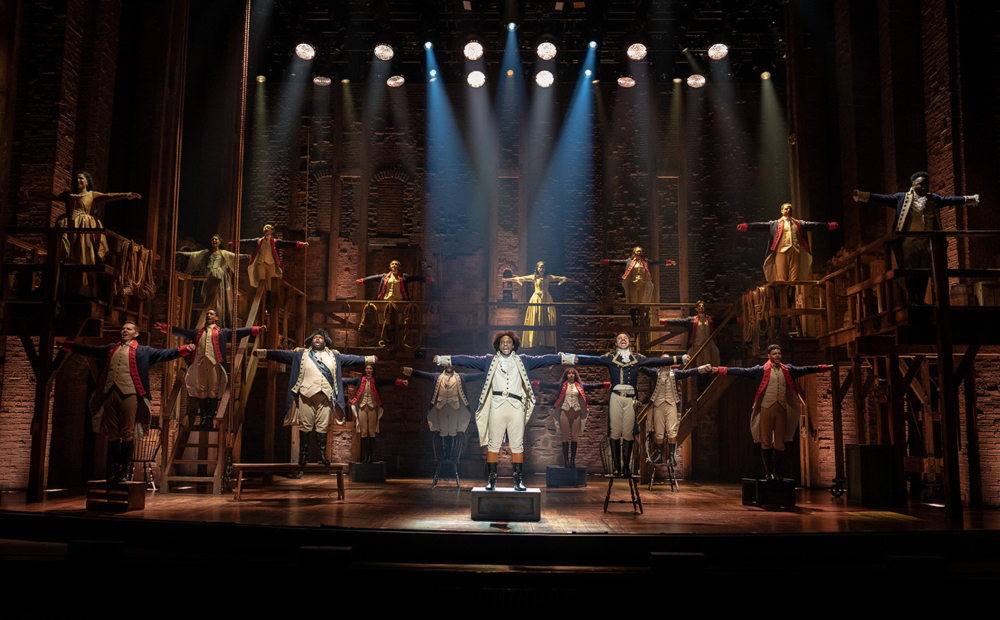
The smash-hit Broadway musical, which won 11 Tony Awards when it premiered in 2016, returned for its third time on tour at DeVos Performance Hall on July 22.
I believe that the worst moment of “Hamilton” as a musical is better than 99% of the other entertainment currently on offer— I’m a pretty big fan of it, let’s get that out of the way. I’ve seen “Hamilton” all three times it’s come to DeVos, but this time was far and away my favorite.
This production has managed to do the impossible— make this decade-old show feel new. The cast and crew felt tightly unified in mission and vision, and their approach to this material breathed a unique and fresh energy into it.
The conductor, a silhouette against the light illuminating his sheet music, did something far more impressive than the metronomic direction I saw during “Les Misérables” or the artistic vocal finesse I found in “Wicked”— he was completely in tune with the music. Sometimes, he’d sway to the song and only cue the instruments. Other times, he’d keep perfect rhythm for both the band and the cast. Occasionally, he’d just jam out to the music and turn pages when needed— trusting the other members of his team to know what to do.
In 2020, a proshot of the original Broadway production of “Hamilton” was released on Disney+. A professionally filmed version of a Broadway musical is relatively uncommon, since it’s expensive to make and many argue it discourages people from going to see the show live. This production disproves that theory, though. Not only did the proshot provide a unique context for this performance, it also makes the unique choices made by this cast stand out even more against the original, highlighting the shared human expression that theatre offers, only available in the moment.
This cast, truly, is the standout of this arm of the national tour. More than other shows, “Hamilton” gives its performers license to experiment with the material and make their own vocal and acting choices, which they unilaterally use to their advantage.
Hamilton, the character, played in this production by Tyler Fauntleroy, had a youthful ambition that bordered on the arrogant and truthfully propelled him through everything he went through with a charming and reckless passion— combined with his rich and perfectly balanced voice, he was fantastic and the best I’ve seen, including the original production on Disney+.
Kai Thomani Tshikosi, Nathan Haydel and Christian Magby, making up Hamilton’s band of fellow revolutionaries, felt like a real group with a genuine sense of camaraderie between them.
Hamilton’s friend and rival Aaron Burr, then, is the counterpoint to this youthful passion. Jimmie Jeter gives Burr a mature facade without losing the vulnerability that reminds us of how unprepared these people were for the monumental journey they were about to embark on. Some of the vocal choices he made and, genuinely, how he breathed made me audibly gasp. His rendition of “Wait for It” was breathtaking, and “The Room Where it Happens” brought the house down.
Hosea Mundi, standby for the role of George Washington, brought a grounding and commanding presence to every scene— with a distinct lack of bravado, reminding us that he has no more practice at this than Hamilton. His breath support and tonality in “One Last Time” was immaculate.
Eliza, played at that performance by Alexandrea Reynolds, had a crystal clear voice that seemed to ring out to the very back row without losing the delicate nature that gave her a heartbreaking turn by the end, and Marja Harmon, as Angelica, made “Satisfied” an intricate dance of beautifully distressing feeling. The tragic act two, “It’s Quiet Uptown,” as usual, reduced most of the audience to a symphony of harmonized tears.
The ensemble, especially important in this show, was a whirlwind fury of pinpoint-precision choreography, the upper-body strength to literally climb on and hang from parts of the set and a scene-stealing presence in every moment— even the unexpected ones. A reflection of how talented the original creative team was, there’s always someone atop or under the balcony surrounding the set, watching silently from the shadows.
If you look anywhere at the periphery of the stage at any time, you’ll find a unique and perfectly planned moment of theatrics— if you can keep your eyes off the dynamic sculpture of kinetic motion in the center of it.
The audience at this performance knew the show well and brought great energy into the theatre. People cheered and laughed in all the right spots, characters got entrance applause— critically, when events in act two got particularly heavy, you could hear a pin drop. The people sitting in front of me, though, seemed to be watching the show for the first time. Seeing them react to the brilliant writing with the same shock and awe I experienced before I had every line in the show memorized reminded me of something I now take for granted— “Hamilton” is a fantastic show.
David Korins designed a set that perfectly sets the stage (pun intended) for the action and comes to spectacular life with Howell Binkley’s indescribable lighting design. The choreography and directed movement are immaculate, designed down to the precise angle of an arm. If you look into the shadows, you see that even the specific moments that props get taken on and off are mapped out so well— it’s rarely right before they’re used, with each prop becoming part of the set itself before it gets taken off the set to be used in the action.
The writing, despite its almost absurd levels of praise from the public and critics alike, holds up and still shines as a unique and gripping work where every word is well-chosen. It’s brilliant from the first lyric and pushes through with unrelenting momentum, each moment melting seamlessly into the next.
When I’m not writing for The Collegiate, I write other things— films, plays, poems, the works. Right now, a play I’m working on is in the stage of development where I send the script to a couple trusted friends and ask them for their feedback. The thoughts they give me will lead me to make some revisions and send the script back to them and we repeat this process until all of us (or, at least the one of us that’s writing it) feels it’s finished. This process, or a variation of it, is what nearly every writer goes through with every project. And while watching “Hamilton,” being in that revision stage, it struck me just how thoroughly and thoughtfully every moment has been workshopped. Every line, movement, shadow and cymbal hit means something and does its job perfectly.
The word “masterpiece” gets thrown around a lot. “Hamilton” is one of the few works that actually earns the title. What I love about theatre is that it’s perhaps one of the most human art forms that exists— each person in the cast and crew brings their unique point of view and set of experiences, and all of these points of view combine to create a unique tapestry that might be completely different on a different night or with even one different person. Even in a show as well-known as “Hamilton,” this cast managed to make that unique tapestry, bringing to it everything they had and highlighting, in the words of Ben Gates in “National Treasure,” the “high treason” these revolutionaries would have been found guilty of if they’d failed.
Sitting in a darkened room with over 2,000 strangers of all backgrounds, all coming from a different place, all agreeing to set down their phones and shut out the world, I was reminded of why I started doing theatre to begin with. Because when you shut out the world to enjoy a show, the world always finds its way back to you. Within the soaring melodies, intricate dance and spot-on breathing, your unique point of view and set of experiences mix with the tapestry on display and remind you what it means to be human— to struggle, to hurt, to feel, to begin again. And then, to leave the theatre to go somewhere new, leaving that experience entirely behind, save for the feelings it engendered within you.
The real Alexander Hamilton seems to have been just as much of a genius as Lin-Manuel Miranda, who penned “Hamilton.” (Though, likely in a different way.) Hamilton built the U.S. financial system from scratch, created the Coast Guard, founded the New York Post and wrote a seemingly endless amount of astonishingly brilliant writing. Even as a writer myself, who has gotten to create a lot of art and who has a creative process that I think works pretty well, it’s unfathomable how Hamilton was able to make everything he did.
Luckily, someone asked him about it.
“Men give me credit for some genius,” he said. “All the genius I have lies in this; when I have a subject in hand, I study it profoundly… My mind becomes pervaded with it. Then the effort that I have made is what people are pleased to call the fruit of genius. It is the fruit of labor and thought.”
When asked a similar question, about how he writes, Lin-Manuel Miranda answered more simply:
“Very slowly, by talking to (myself) in front of a piano until it feels true, and then (I write) it down. It’s as simple as that, and it’s as complicated as that,” he said.
That’s art— simple and complicated, the fruit of labor and thought, made through unique expressions of humanity and seen by a collection of people all experiencing it differently through their unique viewpoints.
Even after a decade of “Hamilton,” with the people making the show and the phenomenal work they’re all doing, that art still feels just as miraculous.
“Hamilton” is playing at DeVos Performance Hall through August 3.