By Gabriel Solis
Paul Thomas Anderson’s “One Battle After Another” arrived at a strange time in U.S. history. Social and political tensions are at an all-too-familiar high, as federal power is exercised on an excessive and unprecedented scale, and average Americans are left to do what little they can to pick up the pieces.
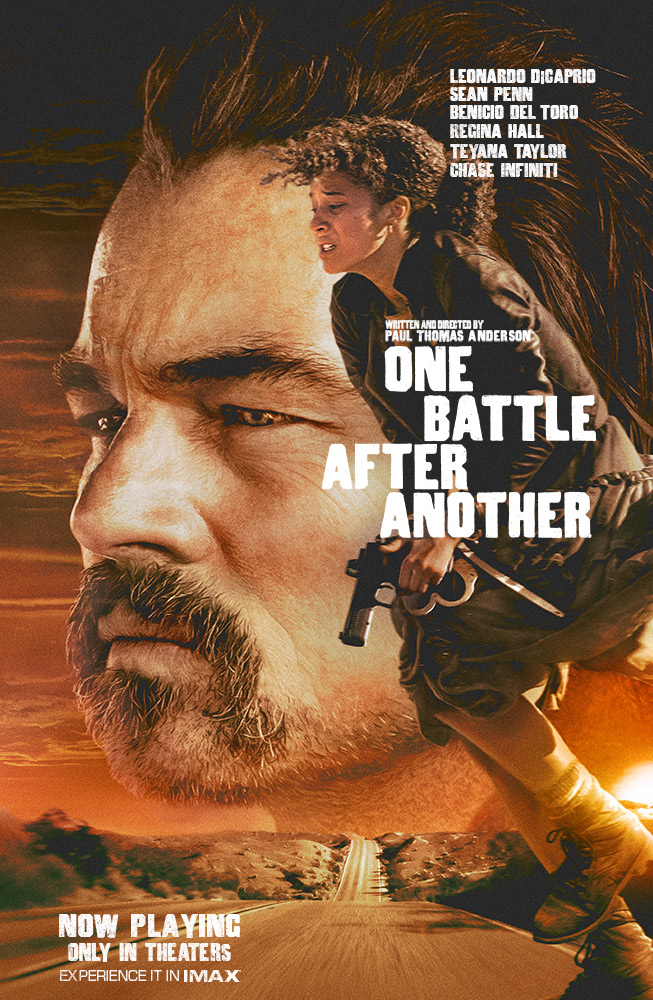
Anderson’s film does not simply address these issues – they are the crux of its message. “One Battle After Another” follows a former radical revolutionary named Bob (Leonardo DiCaprio) and his daughter Willa (Chase Infiniti), who are forced into a life of paranoid retirement following the arrest of the girl’s mother, a fellow revolutionary (Teyana Taylor). Eventually, Bob’s complicated past catches up to them, and the pair is forced to reckon with the consequences of his revolutionary actions and the evils that inspired them in the first place. Through its unique and complex narrative, the film attempts to contribute a rousing cry of resilience and strength to the uniquely challenging situation that currently defines our country. Is it successful? Well…more on that later.
First, let’s address some technical aspects. The score, in an atypical twist of the entertainment industry, was provided by none other than Jonny Greenwood of Radiohead fame. He almost won a Golden Globe for it, too. The addition of Greenwood’s style became apparent within the first five seconds of the prologue, as a delicate piano melody straight out of a Radiohead song danced over the opening footage. His presence remained felt throughout the runtime, as he blended traditional film-score tendencies with that sense of layered melancholy that made him famous. His contribution is one of the most compelling pieces of the film.
The direction and cinematography were other stand-out aspects, for which credit can be split between Anderson and his longtime collaborator, cinematographer Michael Bauman. The unique color palette, dynamic shot composition, and smooth, fluid camerawork contribute to an omnipresent sense of desperation and heightened emotion, lending the film an element of humanity that is not always present in media that attempts to tackle major issues.
These noteworthy aspects alone do not a masterpiece make, however. The main, most pressing issue with this work lies in its pacing. The film moves at a consistently fast speed, which sometimes works to its advantage, delivering a sense of urgency that was almost certainly the filmmakers’ intent. However, this breakneck pace becomes choppy at certain moments and downright jarring at others. Some of the most intimate, emotional moments can feel glazed over or breezed by in the service of maintaining momentum. These moments could have contributed a deeper sense of individual heart amidst the sweeping, grandiose declarations about society, had the film bothered to pause and explore them.
The narrative itself, while unique and compelling, is so complex that it sometimes weighs itself down. Never is this more apparent than at the very beginning, which consists of a prologue that explores the fine details of how Bob and Willa’s situation came to be. This section is no more than 20 minutes in length, and in that short window, Anderson and crew attempt to squeeze a whole separate two-hour movie’s worth of story. It’s the pacing issues of the rest of the runtime dialed up to eleven, made exponentially worse by the fact that it’s the very first impression that viewers get of the film. This makes for an opening that is more confusing and disengaging than anything else. Cliché as it is, the work would have been much better served with an opening paragraph detailing the events, with the rest of the exposition communicated through dialogue. Audiences are smart. They can fill in the gaps.
Now, all attention commanded by the aspects of the film discussed above, both positive and negative, is utterly usurped by the sheer strength of the cast. Some of the best performances of the year can be found in this film. Chase Infiniti, in what deserves to be her breakout performance, holds her own alongside industry titans DiCaprio, Sean Penn, and Benicio del Toro, each of whom turns in laudable work. One can only surmise that Anderson’s direction included copious notes on physicality, because all three of their performances nearly hinge on it. DiCaprio’s bumbling movement, coupled with his genuine displays of emotion and ace comedic timing add some much-needed grounding to the mix. Penn’s rigid mannerisms and gruff way of speaking convey an intensity that defines his character. Del Toro’s calm, controlled demeanor and swift, decisive tendencies are an essential and endlessly entertaining facet of the story.
The film does not shy away from topical imagery. In fact, it embraces it. For example, the first 10 minutes show Bob and crew liberating a detention center for illegal immigrants. The inhumane and reprehensible conditions that befall captured immigrants are displayed throughout the film, and done so in such a casual manner that it almost feels like an afterthought, which is no accident. Anderson (who also wrote the film) wants the viewer to be uncomfortable with how commonplace those conditions are in America. In that way, the worldbuilding does help convey the message – but only in a surface-level way. Really, it is the performances that allow the film to say what it aims to say.
Take Penn’s character, the vile and spiteful Col. Lockjaw, who yearns to be part of a Klu Klux Klan-esque organization called the Christmas Adventurers. This organization carries out hate in a cold, corporate manner, like it’s a nine-to-five gig in middle management. Of course, their message and customs are utterly ridiculous, and the juxtaposition of hatred and evil to a name like the Christmas Adventurers highlights that ridiculousness and the futility of trying to maintain it. The message is only really sold, however, by Penn’s performance. His character, while maintaining a facade of hatred, harbors a secret romantic obsession for Willa’s mother (a Black woman) – an obsession for which he is deeply ashamed. Penn’s ability to balance the most negative of human expressions with the vulnerability and self-loathing that cause them is essential in selling the idea that hate, in all of its ridiculousness, is caused from within. Elsewhere, DiCaprio’s grounded, emotional delivery highlights personal struggles in the face of cultural ones (when the pacing allows for it), and del Toro’s careful, calculated actions and articulations give a taste of what the current social climate is like for those Americans that it affects the most.
At its core, underneath its beautiful score and its unique colors and all of its gems and flaws, this film is about balance and resilience. The balance between hatred and decency, between regimes and revolutionaries, and the resilience of those who get caught in between. Those who know that the war will never end, but refuse to give up the fight…one battle after another.
“One Battle After Another” is streaming now on HBO Max.