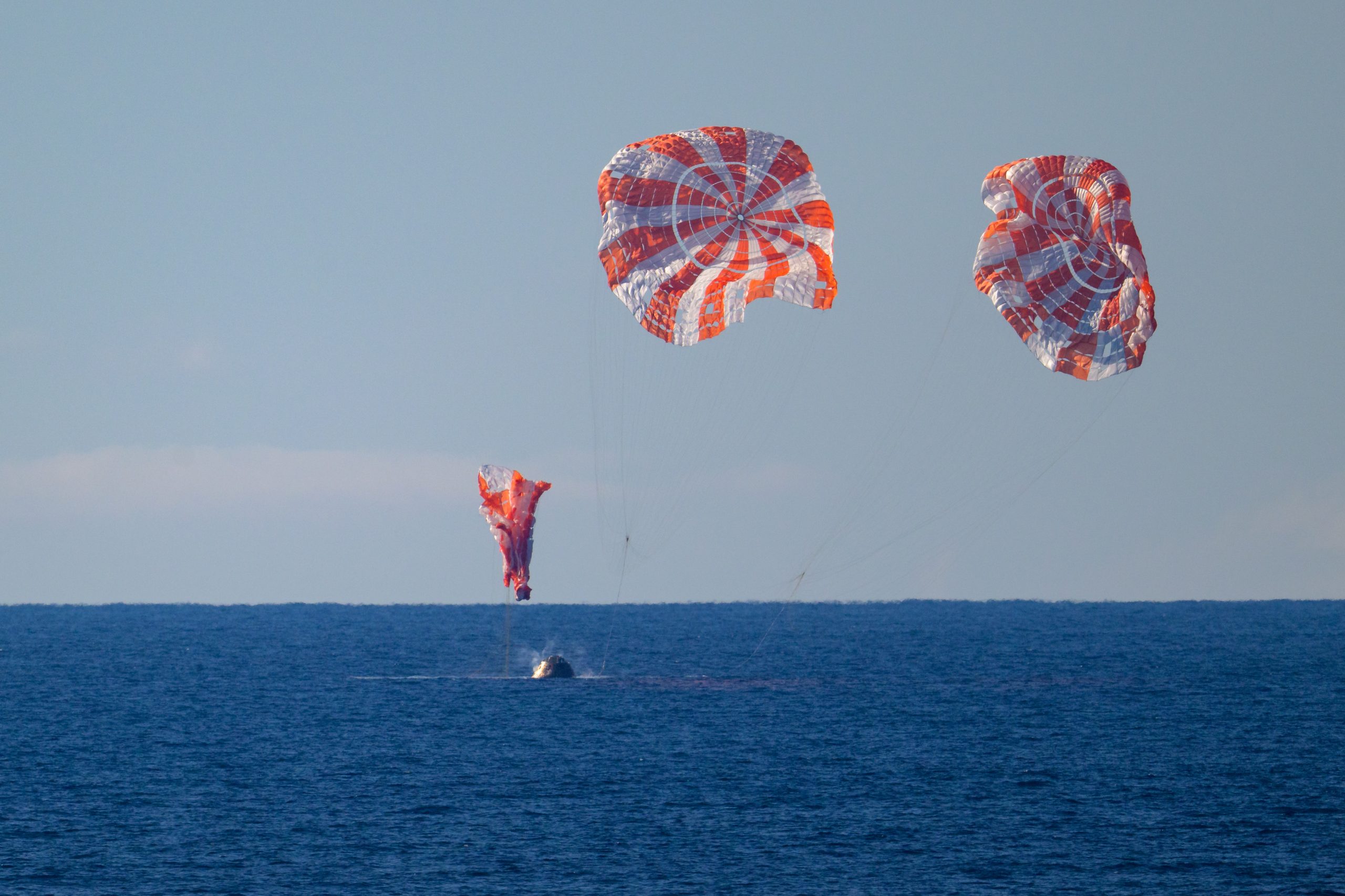
On Friday, April 10, at 8:07 p.m. Eastern Time, the Artemis II moon mission splashed down safely in the Pacific Ocean, near San Diego. The successful trip lasted nine days, 1 hour and 31 minutes and 35 seconds or, rather, 10 days. During a 6-minute blackout, the spacecraft reached its peak speed of 24,661 miles per hour, just shy of Apollo 10’s peak speed of 24,791 miles per hour in 1969.
Despite concern from experts leading up to the return to Earth regarding a heat shield defect, Rob Navais, the NASA commentator, described the landing as a “textbook touchdown for Integrity, Reid Weisman, Victor Glover, Christina Koch, and Jeremy Hansen, back on Earth after a journey around the moon.”
Jared Isaacman, the NASA Administrator, who was aboard the U.S.S. John P. Murtha said on the NASA broadcast, “I’m still at a loss for words. The childhood Jared can’t believe what I just saw.”
This historically important mission began on Wednesday, April 1, and marks the first journey humans have made since 1972. Additionally, Artemis II is not a single standalone mission and is only the first of many missions. Isaacman confirmed this on the broadcast and shared, “We are going to get back into doing this with frequency, sending missions to the moon until we land on it in 2028 and start building our base.”
The United States is not alone in its desire to further space exploration as it finds itself in yet another space race, however this time, the opponent is China. The stakes are higher, though, as modern leaders are focused on marking their territory.
“This time the goal is not flags and footprints,” Isaacsman said. “This time the goal is to stay.”