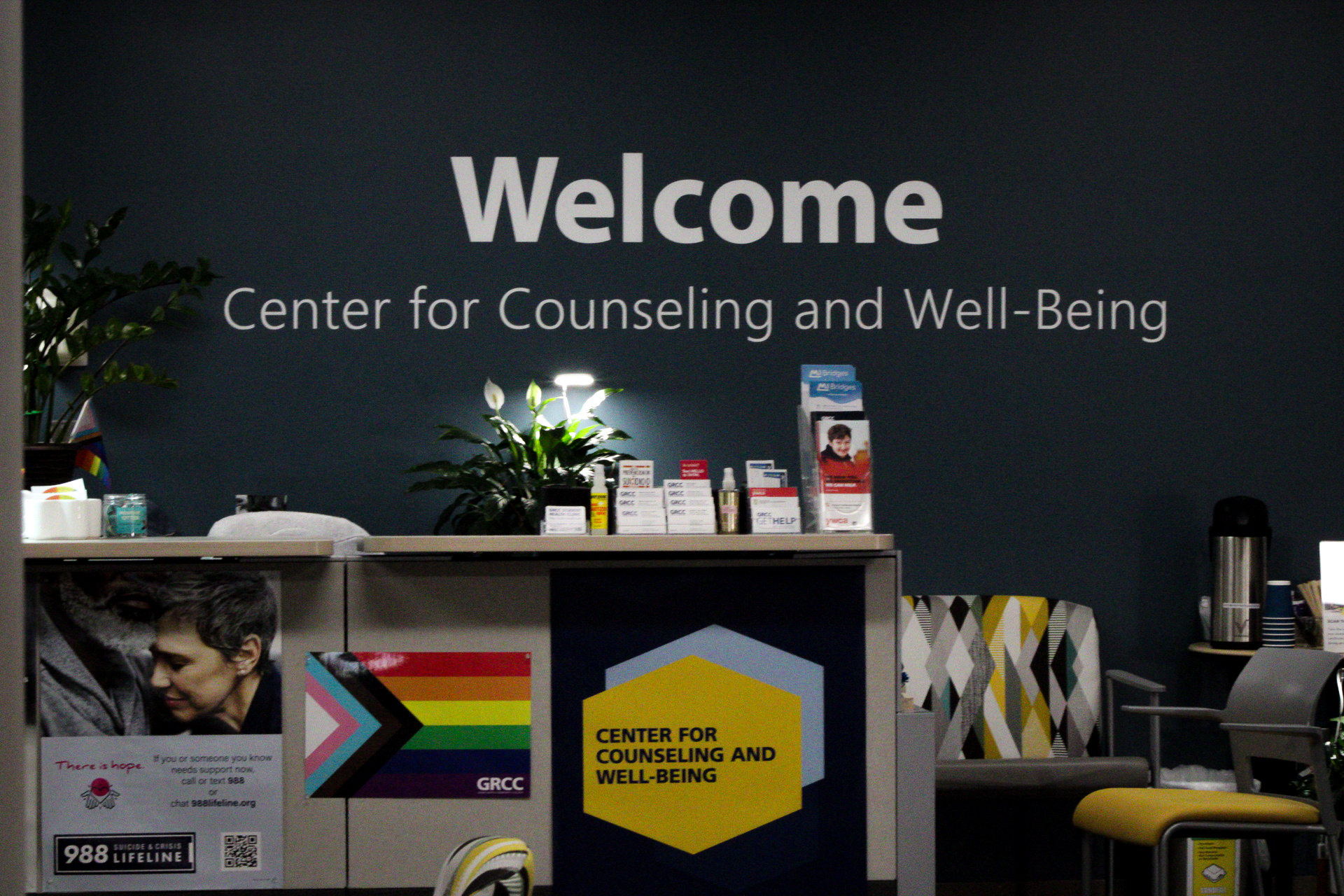
As the First Amendment right to freedom of speech extends into the therapist’s chair, mental health professionals at Grand Rapids Community College discuss the line between a therapist’s right to free speech and their oath to do no harm.
Chiles v. Salazar sought to answer whether the Colorado conversion therapy ban violated the Free Speech Clause of the First Amendment. Kaley Chiles is a licensed mental health counselor in the state of Colorado, providing talk therapy specializing in addiction, trauma, sexuality, gender dysphoria, and other mental health concerns. Chiles treats patients who are seeking religiously-informed care that aligns with the Christian faith, in accordance with the Bible’s teachings on sexuality and gender.
Chiles counseled both minors and adults through their self-identified goals, which would sometimes include reducing same-sex attraction or realigning someone’s gender identity to their biological sex.
Chiles’s argument is that the ban on conversion therapy impedes on her First Amendment right to practice free speech and free religion.
Respondent Kelly Salazar is the executive director of the Colorado Department of Regulatory Agencies and represented the state of Colorado in the case. Colorado took the stance that they stand by the conversion therapy ban, maintaining that it is a legitimate regulation of a healthcare treatment meant to protect minors in the state.
On March 31, The Supreme Court ruled 8-1 in favor of Chiles.
“Conversion therapy” at its simplest definition, is the practice of changing an individual’s sexual or gender identity to align with heterosexual and cisgender norms. People commonly seek conversion therapy if there is a perceived incompatibility between one’s identity and religion, a desire to belong within a community, or coercion from one’s family or religious community.
There are numerous methods of conversion therapy, all proven to be extremely harmful and ineffective in their goal. Chiles practices talk therapy, which seeks to find a root “cause” of a gender identity or sexual orientation that differs from heteronormative standards.
It is important to note that while historically, conversion therapy has included dangerous physical treatments, including shock therapy, all conversion therapy has been proven to be incredibly dangerous for the patient’s well-being and devoid of scientific validity.
Melissa Ware, GRCC’s Center for Counseling and Well-Being Program Director, broke down how her department responds to the recent ruling of Chiles v. Salazar.
“This has been difficult to process. It’s disheartening, especially knowing the harm that these practices cause and seeing this come from within the mental health field,” Ware said. “There are very real consequences associated with conversion therapy. Research shows increased rates of depression, anxiety, and suicidality. People who go through it are more than twice as likely to attempt suicide, and those effects can be long-lasting.”
The Trevor Project is the world’s largest non-profit suicide prevention and crisis intervention organization for LGBTQ+ youth, whose peer-reviewed research has been published in the “American Journal of Public Health,” corroborating Ware’s claim that LGBTQ+ youth who underwent conversion therapy were more than twice as likely to report having attempted suicide. It also highlights that LGBTQ+ youth who underwent conversion therapy are more than 2.5 times as likely to report multiple suicide attempts in a single year.
“Conversion therapy is harmful and not evidence-based. Decades of research show that it’s ineffective and can cause long-lasting harm,” Ware said. “Major medical and psychological organizations have condemned the practice, and it is not aligned with the ethical standards we are required to follow as clinicians.”
The American Medical Association, American Academy of Pediatrics, World Psychiatric Association, and the American Counseling Association all oppose conversion therapy, deeming it unproductive and harmful, and wholly unethical. Research consistently links conversion efforts to Post-Traumatic Stress Disorder, loss of faith, intimacy issues, and suicidality. Clinicians are bound by the principle of non-maleficence, or the “Do No Harm” principle.
Ware explains why someone would seek conversion therapy.
“A lot of what comes up in therapy is tied to identity, how someone sees themselves and how they feel they’re seen by others. When there’s a lack of acceptance in someone’s environment, that can create significant psychological distress, and that’s something we work to support clients through,” Ware said.
“If a client comes in asking for something like that (conversion therapy), the responsibility is on the therapist to say, ‘That’s not a practice I engage in because it’s harmful and not supported by evidence.’ But we would still explore the underlying concern: what’s driving those feelings, what barriers they’re experiencing with self-acceptance, and support them in a way that is ethical and affirming.”
Shifting specifically to the Supreme Court case Chiles v. Salazar, Ware explained the stance the Center for Counseling and Well-Being takes.
“This is not about free speech. It’s about ethical behavior in a therapeutic setting. Our responsibility as mental health professionals is to do no harm,” Ware said. “If we are engaging in practices that are known to be harmful and not supported by research, then we are not meeting that ethical obligation.”
Ware worries about the impact the case could have moving forward, not just in a legal sense, but from a societal standpoint.
“One of my biggest concerns is that people will stop seeking counseling because they’re afraid. We’ve made a lot of progress in reducing stigma and encouraging people to ask for help, and this could be a setback if individuals start to question whether therapy is a safe space for them,” said Ware.
Governor Gretchen Whitmer signed House Bills 4616 and 4617 in 2023, prohibiting conversion therapy for minors in the state of Michigan.
Chiles v. Salazar, in essence, sets the precedent that state legislation can regulate what a doctor does, but not necessarily what a therapist says. This decision makes state-ruled conversion therapy bans stand on unstable ground. Even so, the GRCC counseling center wants students to know exactly how they are supporting the LGBTQ+ community.
“We are committed to ensuring that LGBTQ+ students feel safe, accepted, and supported,” Ware emphasized. “We consider ourselves a safe space, and we work to make sure students feel seen, heard, and understood. We are fundamentally opposed to conversion therapy and do not operate outside our ethical obligation to protect our students.”
Visit TheTrevorProject.org for more information and resources on how to support LGBTQ+ youth.
If you’re struggling, please call, text, or send a message to the 100% confidential 24/7 Suicide Hotline for LGBTQ+ Youth, provided by The Trevor Project.
For any GRCC students who would like someone to talk to, the GRCC Center for Counseling and Well-Being is a 100% free and confidential mental health service, located on the third floor of the Student Center. For more information, visit their website.