By Kyle Jackson
It’s a normal day: you wake up, get dressed for work or school, make some breakfast, and do anything else you need to do before you’re fully functioning.
Once everything is done, you find you have a few minutes to yourself, so you open social media for a quick scroll and find countless AI-generated posts with little rhyme or reason to them.
With AI being a major factor in modern life, details and stories about it quickly become overwhelming and jumbled, making it hard to make sense of it. To add to the pile, debates, environmental concerns, protests, and more are happening constantly, whether for or against.
So let’s take a step back, away from AI, away from the controversy, and ask ourselves, “How did we get here?”
After all, AI data centers didn’t become a thing overnight; they had to come from somewhere.
But to understand where they came from, we first must define what a data center is.
IBM defines a data center as “…a physical room, building, or facility that houses IT infrastructure for building, running, and delivering applications and services. It also stores and manages the data associated with those applications and services.”
The first form of a data center was the US military’s Electronic Numerical Integrator and Computer, or ENIAC, built in the 1940s and completed in 1946.
ENIAC was designed to compute artillery ranges during WW2, but by the time it was completed, the war was over. However, it was able to compute other information with a few alterations, allowing it to handle large amounts of data in record time for the era.
Despite being very different from the data centers of today, concerns about power consumption and cooling were still present.
Later computers, like TRADIC (TRAnsistor Digital Computer) in 1954, and the introduction of servers in the 1990s, made computing information cheaper, faster, and more consistent with less strain on power and cooling.
At the beginning of the 2000s, we began to see the start of our modern data centers, with centers being constructed to support the newly introduced “cloud.” These centers eventually became Hyperscale data centers. This form of data center is designed for large-scale servers for websites, games, and more.
By 2012, 38% of companies used some form of cloud services. The percentage of companies that use the cloud is now around 94% worldwide.
Data centers have changed significantly since the time of ENIAC, becoming larger, privatized, and a major part of our modern lives. The cloud allows websites to function, online shopping, social media, and much more worldwide.
Back when data centers were first introduced in the 2000s and 2010s, public reception was fairly similar to today, with concerns about environmental safety and the local population.
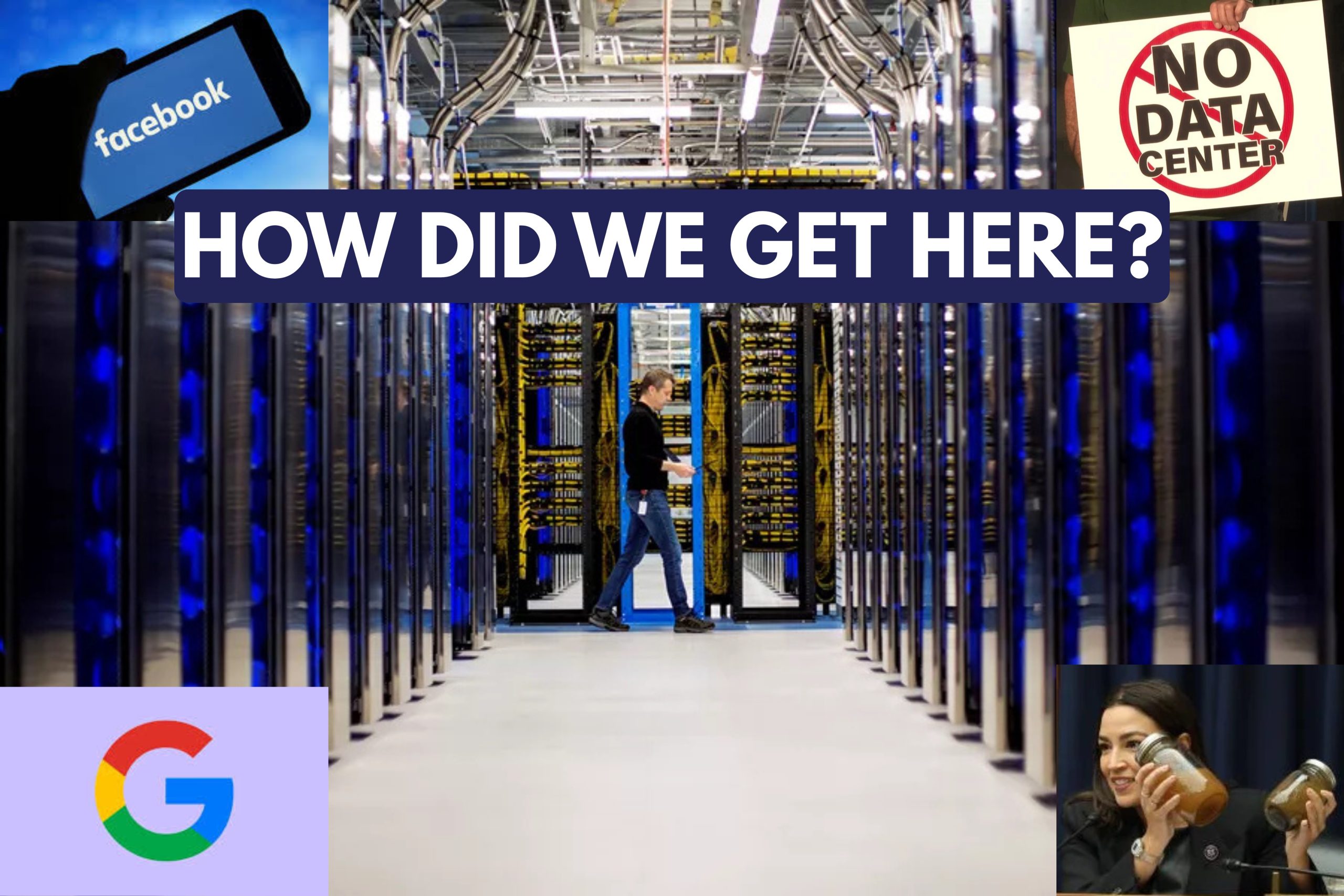
For example, when Facebook began the construction of its first data center in Prineville, Oregon in 2010, Facebook stated that it chose the location for the affordable power, tax breaks, and climate.
The center was welcomed by the local government and most residents. However, much like the cons today, the data center led to increased power costs despite Facebook making promises to keep costs low, leading to some distrust.
Other major companies like Google and Amazon also created data centers in Oregon for the same reasons and had similar results.
With an increase in the construction of data centers, whether they are for AI or not, the negative effects have become more widespread, such as problems with water quality, light and noise pollution, and more.
Today, data centers are mostly being constructed for the use of AI.
These AI models are made for a variety of reasons, most of which are designed to help with “mundane tasks.”
The controversy surrounding AI, such as taking jobs or the misuse of the models, has pushed more and more people to protest the use of data centers and AI as a whole.