By Shy’Ana Thomas
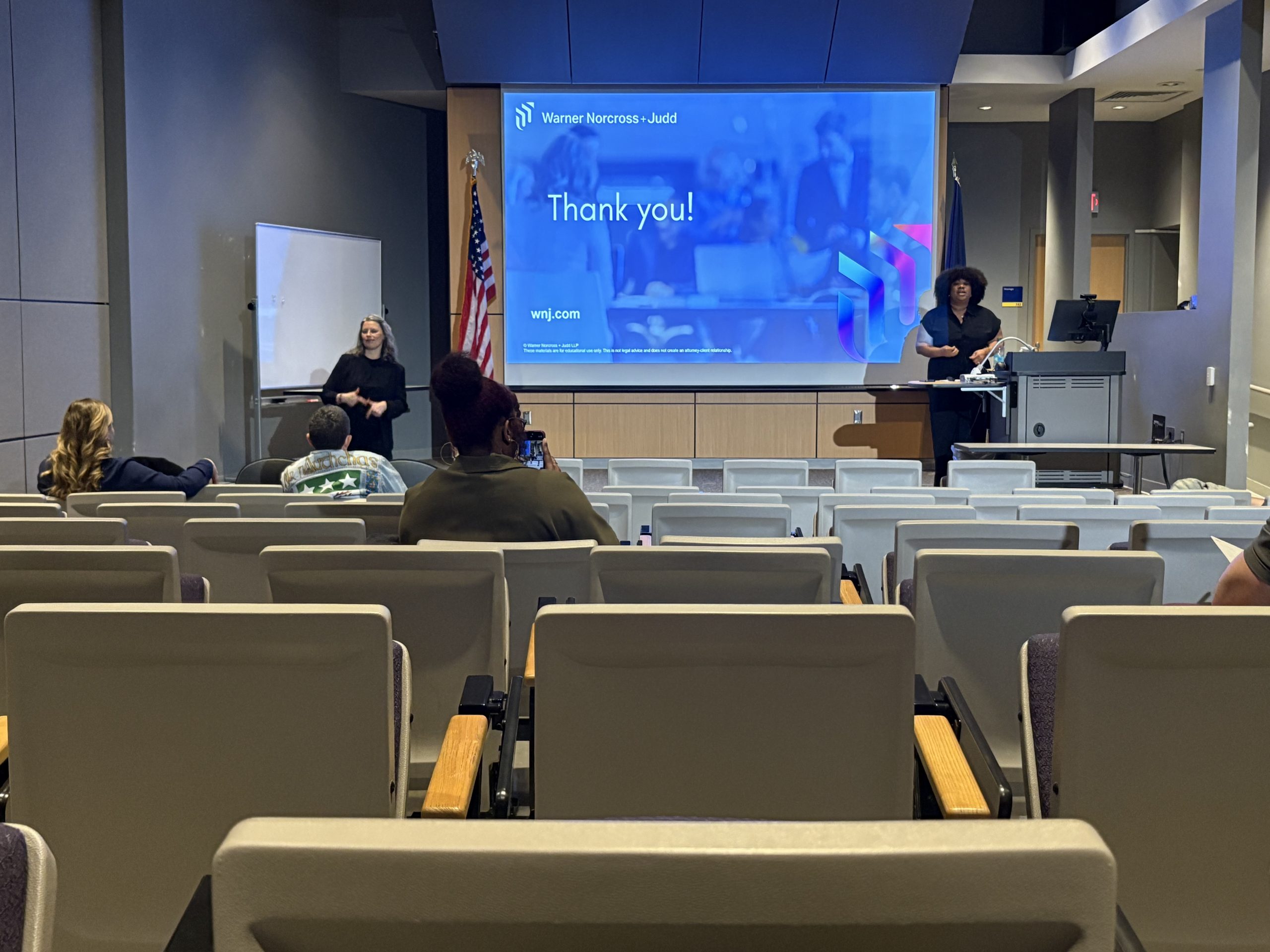
On Thursday, March 13, Grand Rapids Community College’s Woodrick Center for Inclusion and Multicultural Affairs hosted the 30th annual Diversity Series Lecture with guest speaker Mandice McAllister. During the lecture, she talked about the dynamics of power, belonging and the system of influence and how systems can shape the opportunities people can get and access the importance of strategies. McAllister also examined barriers in spaces and power and influence.
McAllister is the manager of inclusion and retention for Warner Norcross Judd Diversity, Equity and Inclusion, which is a leading law firm with over 230 attorneys and nine offices across Michigan, and a certified facilitator and board member of several non-profit organizations. In that role, McAllister is providing internal and external DEI steric-related programs and services to create a more DEI-friendly workplace. She graduated from East Kentwood High School and got her bachelor’s of arts and political science at Ohio State University. She has also won the DEI Champion award three years in a row, from 2021 to 2023, alongside the Diversity Business Leader award and Grand Rapids 40 under 40.
What it’s like to be “The Lonely Only”
What being “The Lonely Only” means to McAllister is not seeing people like her and being the only Black person/person of color in a room or a setting.
McAllister experienced this when she moved to Ohio State University. Her residence hall had a total of five Black people in it. “This is no shade to the Ohio State University, there are probably many reasons for this. The size of my residence hall, where I lived on campus, but nonetheless I did feel lonely only in those two weeks,” she said.
All four of the other Black students in her residency hall were men. When McAllister later connected with another Black woman on campus, they became fast friends.
“Her name is Jessica and we’re still friends to this day and she was in my wedding,” McAllister said. “Now, I went to a pretty diverse high school, but I grew up in West Michigan, so it was not the first time that I had ever been in a room where I was the only Black girl or one of you. Has anybody ever had that experience? You walk in the room, and it’s like, there are not many of us in here. And whatever “Us” means to you.”
What McAllister mentioned next was that those first couple of weeks of college felt very lonely and different for her versus where she went to. But eventually, she did find her community.
“And in those two weeks, I just felt so unanchored, and I wanted to go home every day for those two weeks. I wanted to go home,” she said. “Luckily I didn’t, right? I did graduate. I stayed and I found my community… I love college but those first two weeks and that moment in my life shaped how I navigate space, how I show up, how I build community, and ultimately how I learn to advocate for myself and others.
What’s going on with “DEI” and what does it mean?
Diversity, Equality and Inclusion is an organizational effort that supports the fair treatment of all people. DEI mainly aims to help people who have a history of being treated poorly, being underrepresented and facing discrimination due to core parts of their identity. Benefactors include people of all ages, races, ethnicities, abilities, disabilities, genders, religions, cultures and sexual orientations.
McAllister began to explain the pushback on DEI policies coming from the federal government this year and what it means to her.
“There have been accusations of reverse discrimination there have been very public high-profile individuals, including our sitting president who has been against diversity, equity, and inclusion efforts,” she said.“Why? Why is that happening? I have my theories, but I think I believe that anytime there is a moment of progress and forward movement there inevitably will come a pushback to that progress. And we’ve seen it as a cyclical recurrence in history. You have reconstruction and then they have the rise of the KKK and terror.”
“I think that it’s important that as we continue the conversation that we’re gonna have, this evening. We keep this in the back of our minds, not just the backlash and the heightened scrutiny and the maze. A lot of us have to navigate as new executive orders come out, but how do we face opposition to continue to move the work forward? So, I want us to be thinking about that.”
McAllister quoted a passage from the Civil Rights Act of 1964 while explaining the opposition against DEI.
“This is how I like to define it, in terms of the outcomes that we’re trying to achieve when we do diversity the editing inclusion work. So, when we say that we’re inspiring to have diversity we’re talking about a workforce or a student body that the composition is representative across identity, across the many identities that we see in the world right? That’s reflected in our organization, our institution and our student body. When we’re saying that we’re trying to achieve experience, whether that’s where there is access to opportunity. Where there is well-being and where there is the absence of discrimination, mistreatment, abuse, or harm. Which is the substance of Title Seven of the Civil Rights Act of 1964. Like literally says this word for word.”
Reframing belonging
Reframing belonging helps to create an environment where everyone feels accepted and respected. To do this, experts take a critical look at inclusion, as well as diversity and equity.
McAllister goes into what reframing belonging is and what it can mean to others.
“We’ve been talking about the fact that belonging, you know, is good for engagement and increases job satisfaction. It boosts your bottom line,” she said. “Belonging speaks to the ability of an individual to come into a space to be accepted to feel like they belong to a community. To feel as though they’re appreciated in front of the work that they’re doing in their organization. And lately, I’ve been asking myself. Is that enough? Isn’t that enough? Is that what I want? Do what I want to be in the wrong space? Do I wanna feel accepted, and I’m gonna find? And, yes and right? And so for me, I’ve been thinking about what does it look like personally again?
‘What does it look like for me, for those that I’m in community with to go from acceptance to agency? From fitting into taking up space. That’s different, you fit in, it’s like come down and have a seat. You can’t go to a space and not move over. Move over right? Or I’m bringing my table, right?“
What are system and power?
What a system can be is culture, practices, strategy, policies and structure. Power can be many things, such as positional, relational, expert, coercive, reward and referent.
McAllister breaks down how the two things are important and how they come together.
“So if we’re shifting systems and power, what do we mean by that? What do we mean when we say a system? In this context, we’re talking about the very broad and interconnected policies, which are, you know, concrete laws, rules, and guidelines that govern an institution or an organization,” she said. “We also talked about informal practices and ways of doing things. Have you ever traced them, what are you like I’m going to show you how you’re supposed to.”
“So systems encompass structure, which is how an organization is organized. It also encompasses the strategy, which is how resources are allocated for that organization, for that entity to achieve its mission. And it also encompasses culture, which are the things that we believe and that we value in our organizations or our institutions. And so the word systemic is always lost in the book man, right? And we say things like systemic racism or systemic sexism. What we mean is practices or policies that are interbedded into the systems that produce the outcomes of isms or inequalities. So what does it mean to members implementing interventions, which is what we do in DEI work? That is going to help us achieve the outcomes of diversity equity inclusion, it could look like creating a policy with the supporting practices. That is going to change the job performance evaluation process that make it more fair than by virtue of doing that we’re going to increase the representation of racial or ethnic or gender diversity at the leadership level”
After explaining the different ways to interpret “systems,” McAllister explained what power means in this context.
“What do we mean when we say power? This, again, is not exhaustive,” she said. “These are some of the ways that power can be exerted within systems within our organizations. The first one is the one that we think of most commonly, which is positional power. It’s what’s granted to you by virtue of the position that you hold or the title that you hold in your organization. Your CEO, you do what you want, right? You’re the boss. It’s also relational power, a good friend of mine framed it to me this way a couple of years ago, which is a common phrase. It’s not what know it’s who you know. And also who knows you? It’s very important because you can know a lot of people that don’t know that you exist. And that won‘t speak your name in rooms where you’re not. There’s extra power, which comes by virtue of you having an extensive skill set or being able to exert a level of expertise knowledge, or skill in a certain area. There’s coercive power which is your ability to force a certain behavior or an outcome.”
‘The very opposite of that is reward power. Your ability to incentivize the behavior for the outcomes that you want. When finally there’s referent power which is influenced by the colony. Referent powers are influenced by respect, admiration, or someone’s identification with you. They admire you so much that they are going to see you as a leader and they’re going to follow you. So these are some of the ways that power can operate within those systems. Again, systems are deciding who gets access and to a certain extent, power is operating within those systems to do the very same things.”
What exactly are power moves?
Power moves can stem from the ways in which someone gets their sleeves recognized in rooms to being used as a token person at events and in organizations.
McAllister described these things briefly and explained what these power moves can look like.
“How does power moves to systems work? How does power move within the systems? And that is formal and informal what are the informal networks that are operating and then, after recognizing them? The first step and that’s why my sister said over here we’re talking about people from marginalized identities or historically excluded identities. Sometimes it’s just so powerful when someone comes into an organization for you to tell him like or their look, let me tell you how this works here.”
‘This is what they’re gonna say. This is how it is right? Part of that power move is just understanding how power works, and how systems work. Next is to build coalitions, and I’ve been hearing that here right? Who can you work with and alongside to achieve the common goals? Who are your allies fun fact we do not have to agree on every single thing for us to be allies. That’s how we got into the situation that we’re in right? We don’t have to agree on everything, but can we agree on where we’re trying to get to in my job I have to sometimes immerse myself into the mindset of the opposition. One thing I’ve constantly come to that I need to grapple with is lying you know what really, we’re saying we want the same things. We want meritocracy. We want places of employment where people can come in where they have access to opportunity, where they’re able to thrive off of their hard work and their merit. Now, what we might disagree on is how to get there.”
McAllister went into the different powers, such as ways to get to these places, not having the same opportunities because of skin color and being a token.
“We can agree on the goal, and then let’s come to the table to talk about how we get there so build your allies and part of that is recognizing we go back the power that you have and how it operates in your system. What areas of influence do you have, what places do you need to build in who can you have? Two of my biggest allies in my organization are our managing partner, Markasyn and our mansfield champion, Dan Etting, Mansfield is a yearlong process that law firms undergo. We certify that we’re achieving these benchmarks to increase diversity in law firm representation.”
‘Dan is the partner that spearheads those efforts alongside me, and those two men are awesome. They’re so committed to the work, and they’re always joking with me about being old bald white guys, and every time they say it. I say and I love that about. I love that you are a bald white man because you can go in rooms that I cannot go in as a young Black woman. It’s all about how shearing and it’s all about coalition building so yes, bring your lived experience bring your power and your influence into the coalition. So that we can work towards the goal that we’re trying to get you together, next is leveraging strategic visibility, and so this is a little spicy. Part of this is recognizing which rooms you need to be in to get the work done. What rooms do you need to exempt yourself from? Hot takes sometimes, especially for people with marginalized identities. People of color. Sometimes, leveraging strategic visibility is not deleting yourself out of the situation. Sometimes, you just have to move on. And that’s the biggest power move that you can make.”
“Hypervisbility without influence is tokenism. And so if we constantly find ourselves in spaces where we are highlighted merely to showcase the diversity in our spaces where we are highlighted merely to showcase the diversity in our spaces, but we are not or people that were in community with or rebuilding a coalition with are not invited to be decision making table. Again, maybe sometimes we need to not say, no you may not use my image for the diversity report, or No we’re not taking photos at the ERG event for you to post. This is leveraging strategic visibility until we have some change around here don’t we use our image?
Following all the topics for this presentation, McAllister took the remaining time to have a conversation where people in attendance shared their thoughts and experiences with all topics.
To view this presentation, head over to the GRCCtv YouTube channel to watch the Diversity Lecture Series: Mandice McAllister.