By Kole Meschke
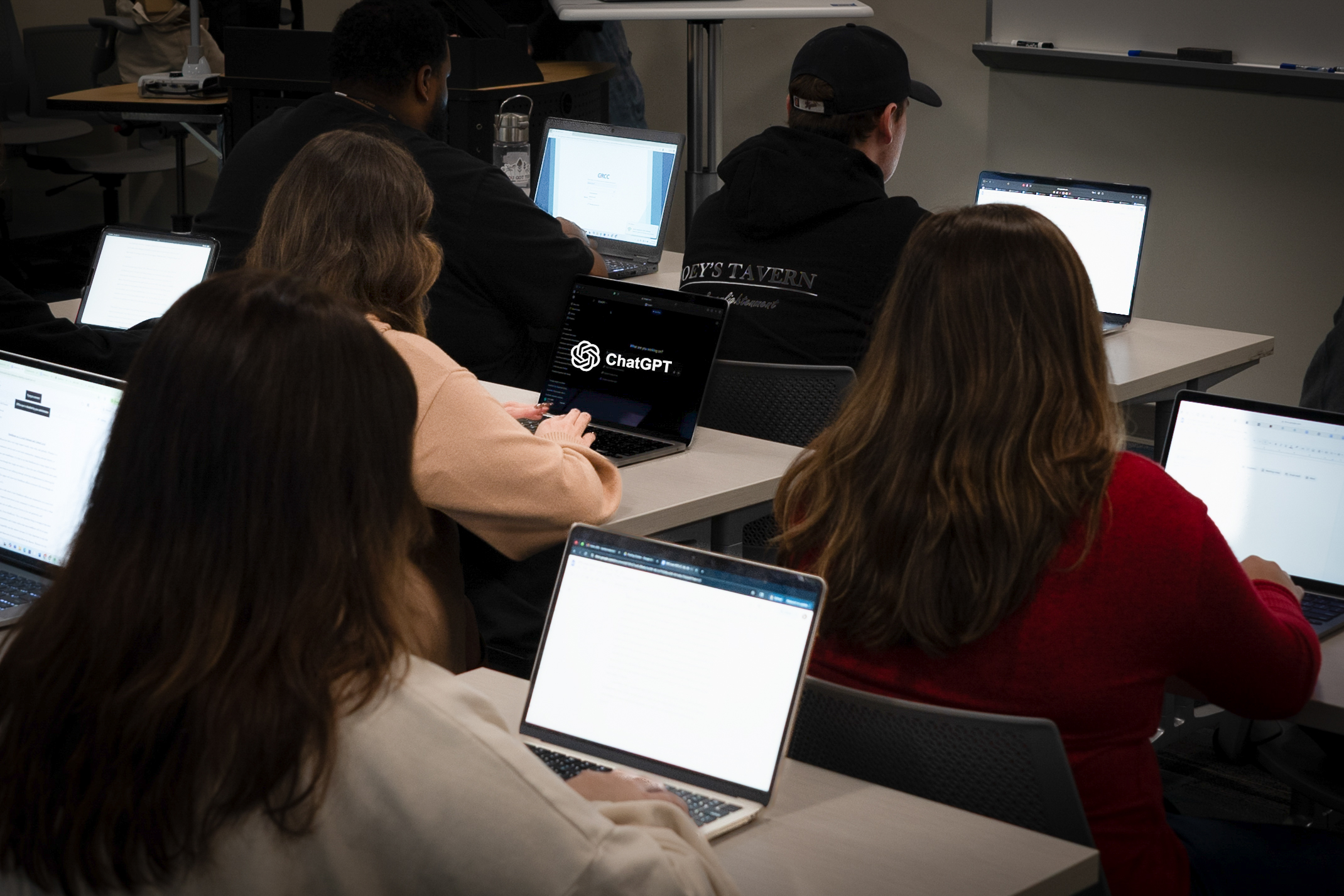
Artificial Intelligence is no longer something out of a tech headline, it’s woven into the daily lives of students at Grand Rapids Community College.
For Ganda Brown, 18, of Allendale, AI is simply another study tool. She uses it sparingly, mostly for definitions and quick checks when coursework gets dense. Her professors, Brown said, generally permit AI as long as it isn’t abused.
“I do use it,” said Brown, “I like that it searches the entire web.”
Kylie Decator, 18, from Wyoming, treats AI like a brainstorming partner. When she’s stuck on a topic for an assignment, she’ll ask for key points to consider. Other times, Decator says she’ll mess with it outside of school, like inspiration for party themes.
“So…if I have to choose a topic about something, I might use it to be like, ‘What are some important things about this topic?’ or if I have ideas for a party, ‘What are some ideas for this theme?’”
Still, Decatur is cautious. She said she’s uneasy about turning to AI for serious personal advice, particularly for mental health struggles.
“I feel kind of iffy about it because you can’t take it as a fact,” Decator said. “The problem is that it kind of lacks empathy. A robot doesn’t have feelings… I think reaching out to somebody that they know (is better) even if it’s a friend, just anybody, just talking.”
For Jen Abbas, a fine art major, the arrival of AI feels far more threatening. Abbas worries about what AI means for artists, not just for their careers, but for the ethics of how the technology is built.
“There are a lot of things that are just unethical,” Abbas said, “AI, the energy it uses… how it’s so easy to steal from artists, to replicate artists. Sometimes, there are even cases where people submit AI art to competitions and win over real artists. And it’s just taking away opportunities for us, but it’s also really shady at times.”
Abbas expressed that their bigger concern is that AI learns by pulling from artists’ work without consent.
“I think the way it’s made is that it takes artists’ work without their permission and uses it as their database,” Abbas explained, “That’s what AI trains on. There could be issues of copyright in that. Artists aren’t consenting to that.”
Their criticism also extends to the environment. Abbas points to the energy and water needed to run AI data centers, and its rapid growth feels unsustainable. “Right now, it’s just so unregulated,” they said. “It harms our environment, but also people could use it in bad ways.”
Not every student feels pulled to AI. Andy Chuck, 21, of Grand Rapids, admitted that he opened ChatGPT once but never felt the need to use it again.
“I never really looked into it,” Chuck said. “I never felt like I needed it. As long as it’s helping, it’s fine. We can get to the point where it helps us. Everyone worries about the movies, like “Terminator” and all that stuff, but we understand what we’re doing to it.”
Others, like James Warkendien, 19, also from Grand Rapids, have already tested the waters and backed away. Warkendien says he used AI once to check his math homework, only to be given wrong answers. That left him skeptical of its reliability and dismissive of its role in creative fields.
“I don’t like it, especially with art,” Warkendien said, “AI might be good if you absolutely need it, but if it’s something that you do with your own skill, you don’t need that.”
He added that AI has already invaded too many corners of daily life. “I keep getting automatic stuff,” he said. “It shouldn’t be used in social media.”
It’s evident that there is no consensus on the use of AI, and many are willing to wait and see what crosses their personal limit, but with new developments daily, who knows when that could be? How students at GRCC, and around the world, choose to interact with AI may very well shape our future.
Collegiate reporters Gabe Solis, Aja’nai Shepard, Francesca Varricchio, Kyle Jackson, and Grace Holmes contributed to this report.