By Jamie Miller
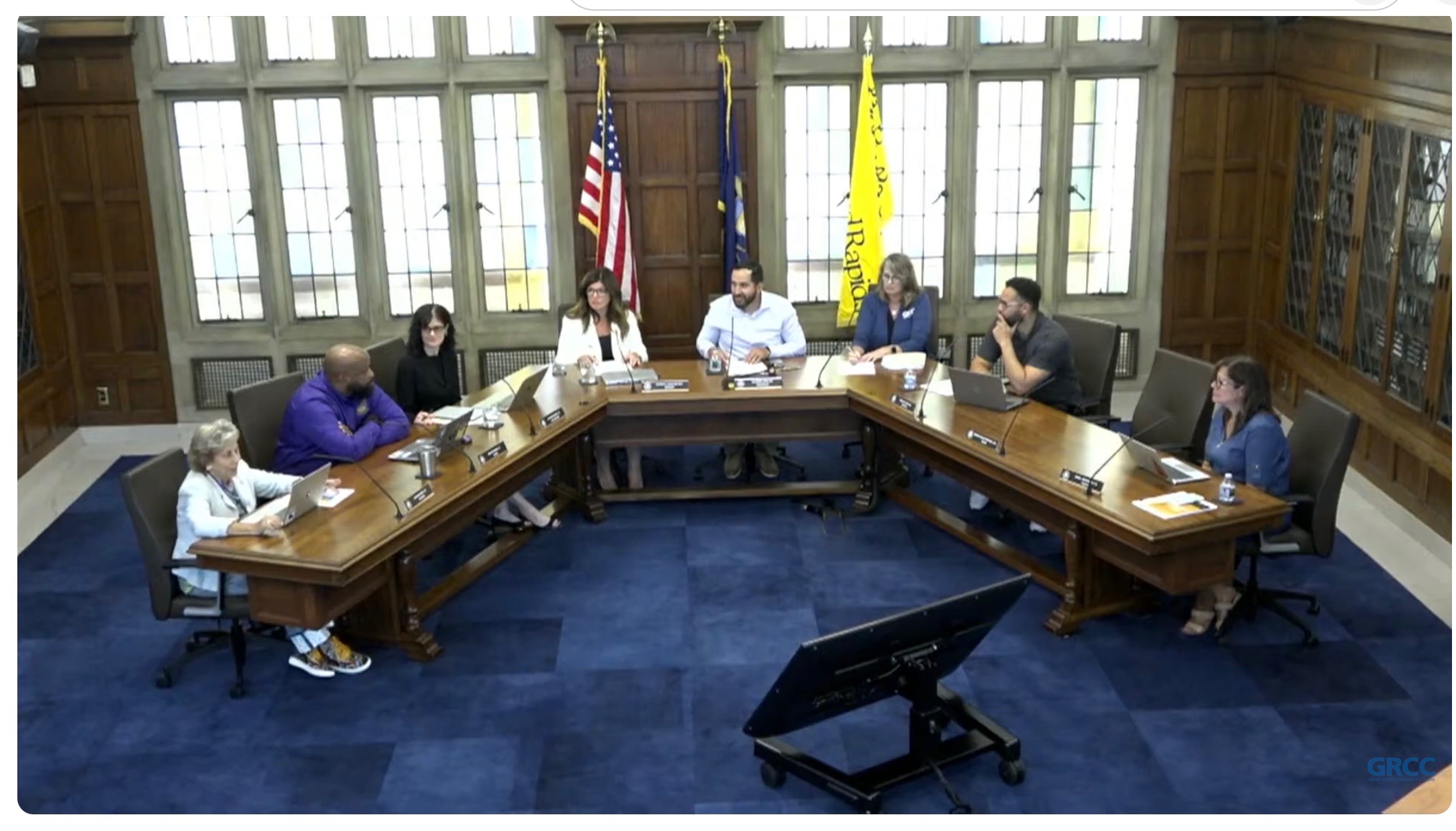
On Monday, Aug. 17, the Grand Rapids Community College Board of Trustees met for its monthly meeting to discuss the budget and approve several contracts and purchases for the new academic year. Near the end of the meeting, board members heard from a GRCC graduate and part-time college employee who described the financial hardships faced by some GRCC employees.
During the meeting, Vice President of Finance and Administration John Globoker and Provost and Executive Vice President of Academic and Student Affairs Sheila Jones explained four items listed for the library. First, Globoker explained the difference between the LIBRIS system and ProQuest: “The Libris system is basically a centralized database of electronic and digital materials; it basically brings all the materials together for that purpose, while ProQuest provides access digitally to more of your arts materials, films, music of that sort.” He continued, “EBSCO provides published research materials, journal access, and then GOBI is also another system for cataloging.”
The board agenda documents library purchase orders for the new academic year worth over $289,000.
At Monday’s meeting, the board voted on purchases worth over $100,000, which passed unanimously. Recent purchase requests included a renewal of transportation services to Compass Coach for bus transportation of the GRCC Athletics for $220,000, more than $263,000 to Casper Corporation for shelves and racks, $150,000 to Game One for athletic apparel and equipment, and $50,000 to GovConnection for “camera equipment and licensing for campus-wide security improvement and scaling.” This is in addition to the college paying more than $62,000 to Van Andel Arena for the 2026 commencement venue rental.
GRCC President Kathryn Rogalski highlighted fall enrollment data and new programs in her report.
“For our fall enrollment, we set an enrollment goal of 12,830, or 3% growth from fall 2025. As of this morning, our head count is about the same as it was last year at this time. While our in-district billing units are up by nearly 4%, what this means is students are enrolling in more contact hours, and we know that’s always a good thing,” Rogalski said. “We’re currently seeing upward trends as compared to last year in online courses (with) our enrollment from 25-29 year olds as well as 18-20 year olds and full-time enrollment,” Rogalski continued.
Rogalski reported that enrollment at the Lakeshore Campus is currently 5% higher than last year. In addition, she noted that GRCC has had considerable growth in its credit for prior learning, including a 121 percent increase in the number of Reconnect students earning credit for prior learning compared to last year. Rogalski also spoke of new certificates that would be given out. “We’re also offering two new Spanish learning certificate programs in partnership with West Michigan Hispanic Chamber of Commerce; they will launch this academic year,” Rogalski said, adding that the School of STEM will offer an artificial intelligence practitioner’s certificate starting in the fall of 2026.
Jones also spoke of how all the funding adds up to help students afford college. She spoke of how someone eligible for Free Application for Federal Student Aid can also utilize Pell or Reconnect to pay 100% of in district tuition and mandatory fees with GRCC Foundation scholarships helping to cover fees that FAFSA or Reconnect don’t, though she did stress that funding gaps remain such as needing to be a full-time student to get access to Community College Guarantee for high schoolers going to college or that funding only covers tuition and mandatory fees with books, transportation and childcare not being covered.
Next, Globoker returned to give an update on finances. Saying that “Overall, the college’s financial performance for fiscal year 2026 remains strong and healthy across all of our primary funds,” explaining that the general fund finished the year with a $580,000 positive variance, bringing the to-date balance to $25.5 million, representing 18 percent of GRCC’s annual revenue, landing GRCC right in the 15 to 20 percent target range. The designated fund ended with a nominal shortfall, leaving a balance of $7.8 million. The building and site fund ended with a $2 million balance, bringing the total balance to $67 million. The parking fund had a balance of $28 million as GRCC prepares to replace Parking Ramp A.
During the open comment portion of the meeting, Marissa Swanson spoke of financial struggles she faced as a support staff member at GRCC.
“Starting out, I’ve always worked a second job, and at times I’ve depended on my family and food banks to make it,” she said. “I did no-buy challenges where you just don’t buy anything except the essentials. And Project Pan where you use up all of your things before buying anything new on top of the many other frugal measures I’ve inherited from my working-class family like walking to work, living with my partner and most recently living with a roommate.”
She further stated how many co-workers have had to move into their parents’ houses, pick up night shifts at Amazon, and have other side jobs. Swanson said directly to the board: “My question posed to you is why does the backbone of GRCC – many of us alumni – have to struggle to stay afloat? You and the students know us; no matter how a living wage is defined, whether that’s MIT, the National Low Income Coalition or through achieving the dream, is there not enough value in our labor to pay us enough to live?”
None of the board members responded to Swanson’s remarks.
The next GRCC Board of Trustees meeting is scheduled for Monday, Aug. 21 at 4:15 p.m.