By Ella Ware
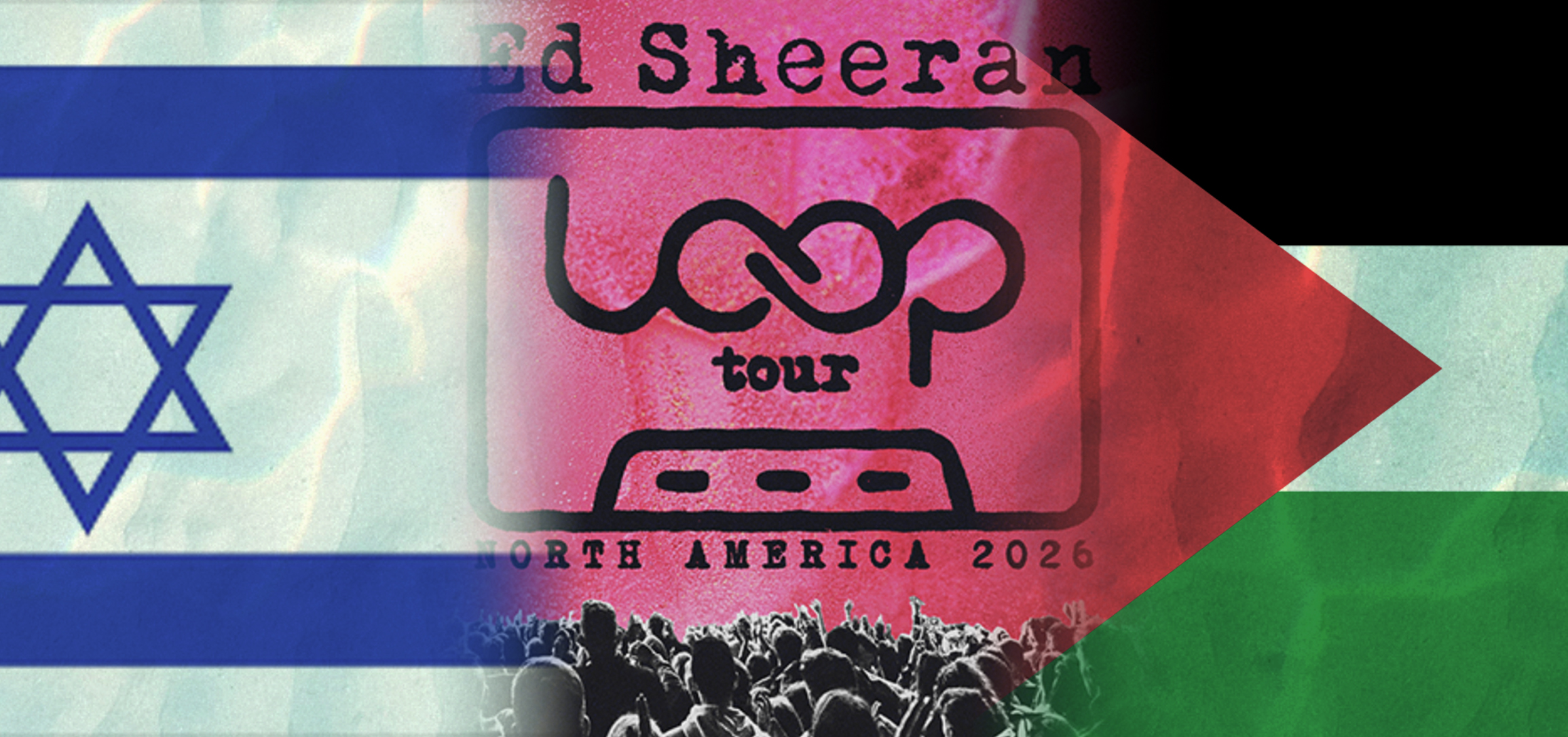
Ed Sheeran has found himself in hot water following a controversy surrounding his 2026 Loop Tour. What was a smooth tour took a turn when Macklemore announced on Monday, Sept. 14 that he was dropped from the tour after making pro-Palestinian comments during a concert.
Days after being dropped from the tour, Macklemore announced his new upcoming tour, “Free Palestine,” on Thursday, Sept. 24.
Proceeds from the tour will go to organizations supporting Palestinians. It will launch in Dublin next month, followed by Paris and London. U.S. dates are said to be going on sale next week.
“What happened to me is bigger than one artist or one stage,” said Macklemore Thursday. “When the billionaire class can decide which voices are allowed on stage and which ones are too dangerous to hear, everyone should be paying attention.”
Macklemore has a history of activism dating back to 2011, when he went to the West Bank to witness conditions under the Israeli occupation. He has previously spoken out about marriage equality and Black Lives Matter.
Macklemore has been outwardly criticizing the violence against Palestine during his concerts for multiple years now.
Macklemore was performing as the opening act for Sheeran on Friday, Sept. 4 when he said, “A big part of the reason why I wanted to do this tour in the first place is so that I could stand up in stadiums like this and say two words that are very, very dear to my heart: Free Palestine.”
He then performed a song dedicated to pro-Palestinian protesters, Hind’s Hall. The lyrics are critical of Israel’s actions in Gaza, and at a show the following day, Macklemore referred to the deaths in Gaza as a genocide.
This caused a controversy to unfold. The Jewish pop star Pink reposted an Instagram story criticising Macklemore’s performance, which went as far as to say that concertgoers were owed refunds and apologies.
Macklemore stood by his initial statement regarding Palestine, and confirmed that Ed Sheeran and his team had made the decision to remove him from the Loop Tour.
“Ed told me that Robert Kraft called him,” said Macklemore. “We were scheduled to play Gillette Stadium later this month, which is owned by the Kraft Group. Ed told me that Kraft said I would not be allowed to perform in his stadium. Ed also told me that Kraft had rallied some of the other stadium owners, and collectively they gave him an ultimatum: ‘If Macklemore stays on the tour, you will not be allowed to play in our venues.”
Macklemore added that there was no neutral position between the oppressor and the oppressed, and that he believed the accusation of antisemitism was being weaponized to protect Israel from accountability.
In a second post two days later, Macklemore committed to donating the entire $1 million of his net earnings from the Loop Tour to six organizations working to support Palestinians, and he invited Robert Kraft to match his donation.
Sheeran made an Instagram post on Tuesday, Sept. 15 in response. He was adamant that he had been communicating with Kraft, promoters, and venues throughout the week to try and find a resolution, but their decision to remove Macklemore was final.
Sheeran shared that the decision was the promoter’s, not his, and that he didn’t want to let down the fans or the other supporting acts and musicians who relied on the tour for work.
Sheeran also added that he does not use his professional platform for politics, because his audience includes young people and children.
In a statement released on the Gillette Stadium X account, Kraft said, “Ed called me and asked me to commit $2 million to match his donation to aid in the region to fight this humanitarian crisis.”
Following Macklemore’s removal from the tour, all of Sheeran’s opening acts dropped out in solidarity, including his touring band, Beoga.
Nonetheless, Sheeran made the decision to continue the Loop Tour without any opening acts.
During his show in Philadelphia on Saturday, Sept. 19, he briefly broke into tears and read a statement off a teleprompter condemning the attacks in Gaza. He also admitted that he’d lost friends over the controversy and had changed the layout of his set because he feared what the audience might do.
“In these situations, you really find out who your friends are. It’s been a weird week,” Sheeran told the crowd. “It happened very quickly. At the same time, I had so many people telling me to cancel this tour, and so many people I’ve known for years and years and years that are kind of backing away.”
Sheeran admitted to considering cancelling the tour, but added: “I see 50,000 people who haven’t abandoned me. People will say what they want, but I am doing this for you. I love you. I love this.”
Collegiate reporters went out to talk to Grand Rapids Community College students about their opinions on the controversy.
Lennox Graham, 20, is an Anthropology major who is a part of GRCC’s choir. Graham agrees with Macklemore’s actions during the Loop Tour.
“Every now and again, I can definitely listen to a Macklemore song. And his recent stance politically has definitely reinforced it. It just makes me a lot more proud to know ‘… I’m supporting the right guy’.”
Ed Sheeran’s private donation compared to Macklemore’s public one following the controversy also didn’t sit right with Graham.
“The difference is because he (Ed Sheeran) was pressured into it due to the backlash, so it seems like he just did it to get people off his back.”
Lily Martinez-Govina and Ana Calacar, both 20, agreed that artists should be free to share their views on the world whenever and wherever they want. Martinez-Govina thinks that venue owners should not be able to take away free speech. She also said that artists should share their political views more because they have the platform to do so.
Martinez-Govina shared that Ed Sheeran’s stance, from what she has seen, is apolitical, and Sheeran seemed to be trying to silence Macklemore.
“I almost disagree with (separating artists from their music) because it reflects what your beliefs are on certain things.”
Hakeel Anderson, 25, is a Computer Science major who feels that artists should, if allowed based on contractual agreements, be able to use their platform as they wish. He stressed that it’s important that it’s an issue that they actually stand for, and that they don’t just do it to get a reaction out of people.
“I mean, it’s cool if they feel strongly about it. If they’re just talking about stuff just to get a rise out of people, then, you know, just don’t even bother. If they’re serious about whatever the cause is, go for it,” said Anderson.
Collegiate reporters Audrey Conrad, Izabella Blanchard, Kora Locke, Litany Gaines, and Sophia Vry contributed to this report.