By Kyle Jackson
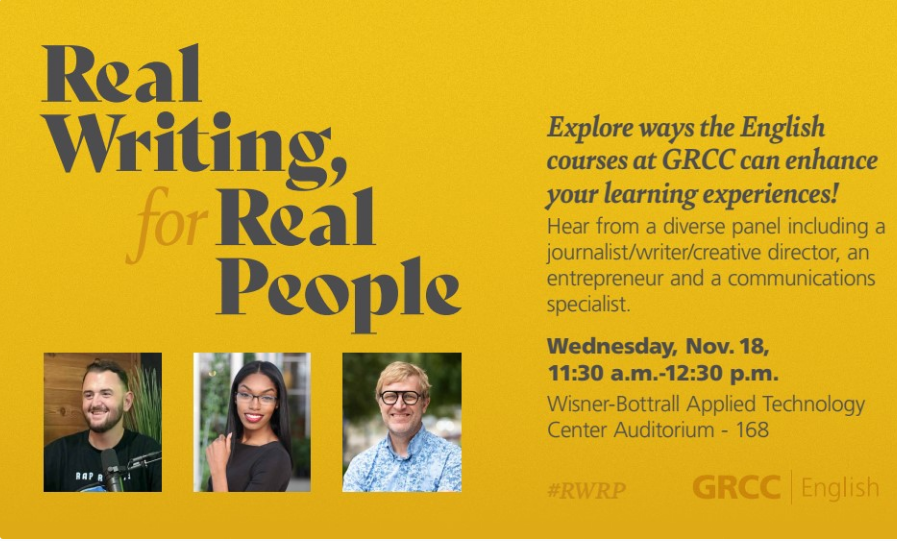
On Wednesday Nov. 18, the Grand Rapids Community College Applied Technology Center hosted Real Writing, for Real People, a presentation connecting first-year college writing courses to real professions.
The presentation was open to anyone, offering complimentary catering in addition to the main presentation.
The panel consisted of Brayden Flodin, a music journalist and the founder and creative director of Rap Roots Media, Denavvia Mojet, founder of Mojet Counseling, who has received several accolades, and Ryan Nausieda, Communication Systems Specialist at GRCC.
Flodin was the first to speak, highlighting his experience starting up his business coming out of college.
“I just was coming here because, you know, you’re here for your parents. You’re supposed to go to college, get this career, and all these things,” said Flodin. “So, I made it a mission during my time here. What do I want to do?”
His decision ended up being writing, leading him to pursue music journalism.
“I’ve written stories about musicians that I had never heard of before, that I had never spoken to before,” Flodin said. “And it becomes interesting because you research, and you learn, and you develop things that develop concrete ideas. And I think the first part of doing that is simply getting words on the page.”
Flodin expressed that his experience at GRCC allowed him to find his passion.
“I love connecting with people. I love talking with people. It’s something that is so fulfilling, especially since COVID. I feel like a lot of people say Gen Z is such an anti-social generation. And that’s something that I never liked… So I wanted to be the exact opposite of that,” Flodin said in a separate interview. “So talking to people face to face about a topic I care deeply about has always been a huge blessing for me to be able to do.”
The next speaker was Mojet, who focused on her personal experience with communication in all aspects.
“…my mother used to say, people don’t get a raise around here if they don’t have a college degree, so they’ll just use your face and how good you are with people to get programmed outcomes at these nonprofits, but they won’t pay you what you’re worth unless you get degrees and if you really know how to speak their language,” Mojet said.
Mojet explained her college experience, stating that while her initial introduction to college life was less than ideal, she managed to attend GRCC instead and found a network of people that allowed her to expand her career.
“I am a strategist. I’m a movement organizer, and I do that all across the state of Michigan and occasionally all across the country,” Mojet said.
Finally, Nausieda took the mic.
“I was a terrible high school student. And I graduated from GRCC in the 1900s. So during that time, during that time that I was here, being a terrible high school student coming into this institution, it was a huge learning curve,” Nausieda said.
Nausieda continued by highlighting his experience at GRCC, explaining his first experience with college poetry classes.
“I was terrified because I’d never written a poem before,” Nausieda said. “And there’s one poem I wrote… I thought I was special and I thought I was doing great work. And everybody else in there was like blowing my mind with the poems they were writing. I wrote a poem that looked like a coat hanger, and I brought it in, and I showed it to everybody. And it was a terrible poem.”
Nausieda explained that his experience shaped how he views communicating for his current job.
“It’s all about writing and making sure that we’re connecting with you. We have to understand students to be able to send those messages. That’s our number one priority: to make sure that we profile,” Nausieda said.
After the speakers concluded, they were invited to sit as a panel for the crowd to ask questions.
The first question asked the panelists their views on AI in their respective fields, to which all of them answered that they use AI daily but not for creative work.
The second question was specifically directed toward Flodin, asking him if he consumes music differently in his profession. Flodin stated that it has prevented him from consuming music recreationally.