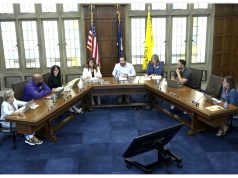
On Aug. 17, Caledonia Township held another public meeting discussing the current draft of the township’s special land use data center ordinance. The meeting was set to discuss a special land use for a company called Platinum Ponds, but it was pushed back to the next meeting due to the owner not being present. There are currently no plans to construct a data center within the township due to a moratorium that is in place for the next two months, ending on Oct. 17. Township officials say they hope to have the ordinance in place prior to the expiration date. This meeting’s full agenda can be found here.
The meeting began with a standard brief public comment period. During the period, multiple residents spoke about their concerns regarding data centers and how they should be zoned, highlighting various issues such as the noise problems in Dowagiac and the current master plan for Caledonia Township in their respective arguments.
“I had a high school reunion in South Mishawaka a couple weeks ago, and on the way home, I told my wife, I said, ‘Let’s just swing by Dowagiac because it’s in the news and people are suing because of the sound situation,’” said Greg Cummage, a resident of Caledonia Township for over 40 years.
Cummage described his experience at the data center, stating that the noise could be heard through his car windows, reaching 60 decibels with the windows up. He expressed concerns about this also being the case if a data center were to be constructed without proper protections and restrictions.
Deb Steketee, another resident, shared similar concerns about the noise, highlighting the vibrations from said noise and ways that the ordinance should address it.
Steketee stated that the proposed ordinance should better define neutral impacts, have clearer guidelines for how noise should be measured, and address noise that can’t be heard.
The meeting raised contradictions between general provisions for special land use and current proposals for alterations to special land use if a data center wishes to use the land. These were explained as a way to ensure any data center business follows the same structure of special land use with their higher resource demand. It was argued that the general provisions should only cover accessory buildings rather than the entirety of the property.
The meeting also covered other aspects of the current ordinance draft, namely, clarification on having the ordinance require community impact analysis for special land use, including temperature change originating from data centers for air quality impact analysis, highlighting the current accepted noise levels and available responses if it isn’t followed, defining day and night hours, fire protections for data centers, how to adequately estimate funds for decommissioning a data center, generalised power consumption concerns, and how to properly enforce the ordinance.
“Do we go out there with a decibel meter and say, ’ Well geez, it’s 65 decibels at the property line,’ do we just write them a municipal civil infraction ticket for $75 or whatever it is allowed to be? How do we police this?” said commission member Tim Bradshaw.
With these discussions, some concerns about the ordinance not applying to current land arose, potentially making the draft an exclusionary ordinance, or an ordinance that exclusively impacts one form of business, unless other ordinances are expanded.
“…but we want to get it right,” said Chairperson Doug Curtis, concluding the agenda.
Toward the conclusion of the meeting, the public comment was reopened and extended to five minutes.
Steketee used this time to reiterate her concerns about how the noise should be calculated for the ordinance.
“…Somebody going up with a little decibel reader and asking ‘what is the amount of noise here?’ That’s not how the noise needs to be calculated. It needs to be a continuous, an LEQ, a continuous level to accommodate the big noises, the small noises, and it basically averages it out,” Steketee said.
LEQ represents the average sound level for a designated period of fluctuating sound.
Steketee continued to state that the noise should be measured over an extended period of time and be held to a common compliance matrix to better enforce future infractions.
Daniell Grassid, a resident of Caledonia Township who lives on the border of Gaines Township, also spoke during the meeting, stating that she has a child heading into preschool near their data center and asking the board to collaborate with Gaines Township on the ordinance.
“And so, if you guys could make a community, I’ve been to the school board meetings, and I’ve talked to them. What can you guys do to talk with Gaines to make sure that you guys are doing a great job with some of your really specifics?” Grassid said.
The board discussed requesting another extension of the current moratorium. They were quickly informed, however, that they have already placed a recommendation to the board of trustees and that another doesn’t need to be sent.
The board did not make any immediate changes to the ordinance during the meeting.