By Anane Badom
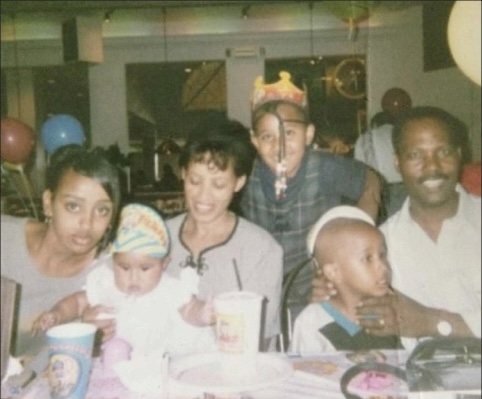
I arrived in Boston, Massachusetts from Khartoum, Sudan in July, when I was just 2 years old a month before my third birthday. I don’t remember anything about Sudan but I have vivid memories of our first car-less winter in Boston.
I remember “borrowing” grocery carts from the store to push our groceries home in the snow. We would return the carts on our trips back, only to borrow them again. (You can probably thank my family for shopping carts with locks on them.) I remember the snow being so deep that it went over my boots, I remember my feet feeling so frozen and numb that it felt like more of a burning sensation. I would scream and cry for the duration of the whole walk. I remember trailing behind my mother, watching her carrying my baby brother on her back wrapped in blankets and struggling to push the loaded grocery cart through the thick mushy snow.
I remember one time, a kind white lady stopping and giving us a ride home. When the woman stopped her car in front of us, I immediately helped myself into the warmth of her car without saying a word. My mother spoke no English but pointed in the direction she needed to go and the woman loaded our groceries into her trunk and drove us home. She helped us carry our groceries into our apartment. I watched the woman and my mother share a long hug goodbye. My mother had no words, just tears in her eyes and she gave her a sign of prayer hands and a head nod. The lady did it back.
In second grade we watched a documentary on lions. In this documentary there were people who were dressed in small cloths covering only their private parts. My teacher pointed at me and told the class that lions lived in Africa, where I was from. I responded, “I’m not from Africa. I’m Ethiopian.” She assured me that I was indeed African.
When I got home I ran to my mother and asked her if we were African, looking for some information to prove my teacher wrong. My mother told me that we were definitely African and that Ethiopia was a country in Africa. I had no idea I was African and in that moment my heart sank. I didn’t want to be identified with people who didn’t wear clothes. “How come we don’t dress like that? I never see you dressed like that in your old pictures back home and how come we aren’t as dark colored as them?” I asked.
My mother gave me a scenario to imagine. “Imagine if we went to the Amish community here, and recorded their lifestyle and advertised that as North America for all of the Africans to see who had never been to America before. They don’t know that Africa is so big and diverse and that there are so many different cities, clothing styles and races of people in Africa.” I understood and accepted the fact that I was African.
In fourth grade I had a teacher that I would try very hard to please. This teacher accused me of cheating on a few occasions and even made me retake a test alone during recess one time because of this. One day she was teaching the class about gravity and my afro puffs became the example of how gravity didn’t always work unless something had density. I was embarrassed to be the topic of discussion and this lesson only intensified the feelings of hate I had for my afro textured hair. That day I went home and begged my mother to make it straight like the other girls or at least make it stay down. She gave me braids with beads on the ends and I went to school feeling better that my hair was finally obeying the laws of gravity like everyone else.
In fourth grade, I had a best friend, she was biracial. Her mother was white and her father was Black. My best friend’s parents’ separated when she was a baby and she was raised by her mother and stepfather who was white. One day she was passing out invitations to some girls in class for her birthday party. She told me she wanted to invite me but couldn’t because her step-father didn’t like Black people. I thought it was odd since she too was technically Black but I didn’t say anything.
In fifth grade I had my first Black teacher. I would often come to school with my jacket and backpack smelling like whatever my mom was cooking the night before. Many of the kids said that I smelled bad and didn’t want to sit next to me. One day my teacher told me, “I need to try whatever your mom is cooking because it smells delicious!”
I told my mom and she sent me to school with a pan of Ethiopian food the next day. He ate…no, he DEMOLISHED the food in front of the whole class. He licked his fingers and asked me to bring leftovers whenever we had any. My mom was so happy that he liked it that she prepared a few lunches for me to bring to school for him throughout the rest of the school year.
After complaining to my parents that I wanted to be around more Black people, they sent me to an urban public school. In sixth grade, I attended a predominantly Black school but surprisingly enough I was often made fun of and called “African-booty-scratcher” by Black kids. I laugh about this now too, but back then I would break down and cry when I got home. The kids would joke about my “cousins” on the “Feed the Children” commercial. I was even told to go back to Africa. I thought it was odd that people who shared the same African ancestry as me would say this to me. I was always a quiet person and kept most of my feelings to myself at school but I did share everything with my mother when I got home. She would try to make me feel better and tell me amazing things about our country. She taught me that coffee was discovered in Ethiopia and that Ethiopia accepted Christianity even before many European countries did. One day I asked her why we left if it was so great? She told me that there was a lot of poverty, tribalism and discrimination and that she had to leave if she wanted to survive. She told me the story of when she was kidnapped and forced into child slavery from when she was 9 years old up until she was 11 years old. I didn’t understand why she still loved her country.
I asked my father the same question and he told me about his struggle for equality, too. He told me that if he didn’t run away to Sudan, the government would have killed him. Sudan is where my mother and father met while living as refugees and where I was born. An American church sponsored us and brought us to America. My father told me about my grandfather and that he was killed less than a year after he left, but my father couldn’t even go back for the funeral or he would have been killed, too. He would later lose his only brother, too. Despite all this, he still missed his country and sometimes felt lonely and homesick. I didn’t understand why he would miss a country like this.
America was a blessing to my parents. Coming here and having an equal opportunity to work and provide for their family was a chance many people dream of. My parents never saw themselves as victims to systematic racism because they had suffered first hand traumas at the hands of people who were the same race as them. To my parents, white people seemed like the heroes. My parents raised us working menial, laborious jobs and felt that their inability to get ahead or promoted at work was because of their accents, language barriers and lack of an American education. Despite this, they were still happy to live and to raise their children in America. They felt that their children would have a better chance at education and success than they did.
When I was moving into my dorm at Michigan State University, I had a very embarrassing and public racist experience. As we were unloading my parents car, a boy yelled from a window on the top floor of Akers Hall, “Go home N*****s!” My parents and I looked at each other shocked and frozen. The whole parking lot full of people fell silent and everyone was staring at us. My father carried on unloading our car and time started moving again. My mother cried when we got inside my dorm room.
When I was 19, I was deservingly arrested for a DUI. I was a sophomore at MSU and was driving home from a frat party. It was my first time ever being pulled over or interacting with the police. A few days later my white roommate came home drunk late at night. She told me that she had been pulled over for drunk driving and that the officer told her to park her car and walk home because he didn’t want to ruin her clean criminal record. I wondered if I was white, would the officer have cared about keeping my criminal record clean? Or if the officer who pulled me over was Black would they have cared about keeping my criminal record clean?
One summer when I was home from school, I picked up a part time job waitressing at a local casino. I would often wear my hair in braids because that was the easiest long-term style I could have without having to spend an hour detangling everyday. One day I noticed a new poster in the break room with pictures of appropriate and inappropriate hairstyles. Braids were on the list of inappropriate hairstyles. I came back to work the next day with the same braids but this time, I tied them back to be more “professional.” I got pulled into the office by my white male manager and he asked me if I had seen the sign. I replied, “Yes, that’s why I tied my hair up in a bun.” He responded that exotic hair styles didn’t go with the culture there and that some customers had complained about my hair. He politely asked me to take my braids down before my next shift. I told him this was discrimination and that I should be able to wear my hair in braids. He said he would talk it over with the higher ups. Throughout the next month, I got written up for random tiny mistakes and after the third write up I was fired.
In 2016, My younger brother got into some trouble with the law and was in jail. His race was definitely a part of the reason the police assumed he was guilty. I went door-to-door downtown with my parents looking for a lawyer that we could afford. After sitting with one lawyer and telling him our story, he told us his rates started at $20,000 and I told him we couldn’t afford that. He apologized that he couldn’t help us. Later that evening he called me back and said that he told our story to one of his retired colleagues and that he agreed to take on my brother’s case as a charity case and that we only had to cover the cost of the private investigator he would hire. He said that he could see we were a good family and he really wanted to help us. The lawyer he connected us with was a former federal prosecutor and he was one of the best lawyers we could have had in the state of Michigan. The lawyer got my brother out of jail the next day. All charges were dismissed and my brother was released with no criminal record.
Now as an adult I have finally fully embraced being Black and African and I see the beauty in myself (and my hair). I traveled to Africa a few times. I went to Ethiopia once when I was 15 with my mom, then to South Africa and then to Ethiopia again more recently. I see that many things have changed in Ethiopia, but I can’t say that the country has fully reached a state of peace, prosperity or equality or that poverty is no longer an issue. Going back to visit Africa makes me feel ashamed to share my first world problems, knowing that my struggles are nothing compared to what many of the people still living there still have to go through or even what my parents went through. Despite the hardships, poverty and corrupt political systems in Ethiopia, I still see the beauty in the traditions, culture and history of Ethiopia. I am proud of being Ethiopian and African. America is not perfect either but no country is perfect and I feel blessed to have been raised in America and I am still proud to call myself American.
I have finally achieved that state of peace that comes with surrendering and not worrying what others may think of you. For so long I lived suspended between two cultures and identities, never truly anchoring myself or building a foundation on one. But now, I am no longer searching for belonging, acceptance or home because I realize that home is where your heart is. I feel so blessed to live in a country where I have the opportunity to pursue my passions, to grow and to learn to my fullest potential.
I am 31 years old now and I’m back in school at GRCC full time. I feel so blessed to have the opportunity to pursue my passions, to grow and to learn. I am married and a mother to two beautiful little boys, Raji and Yona. I also have one more boy on the way. I look forward to creating new traditions with my family and becoming a part of American history. I hope I can pass down to them what I learned in school from the great Martin Luther King, to love people based on the content of their character and not the color of their skin. I know I have to warn them that they may experience racism, discrimination and prejudice but I also warn them not to live life in a state of fear, victimhood and defense. I want them to know that our perceptions shape most of our reality. I hope they learn that not every negative encounter is because of their race. I hope they understand that there are good people and bad people from every race, religion and country.
Even though we live in a scary time of random mass school shootings and where it’s not uncommon for Black men to die unjustly in the hands of police officers, I know that kind people exist in this country because I have experienced them first hand. I also know that crazy people exist, too, but I choose to live life looking for the positives. America is now my home and I see the amazing strides our country has made as a whole to have more equality and justice. I do not fear the future, I have faith that God will protect us all.