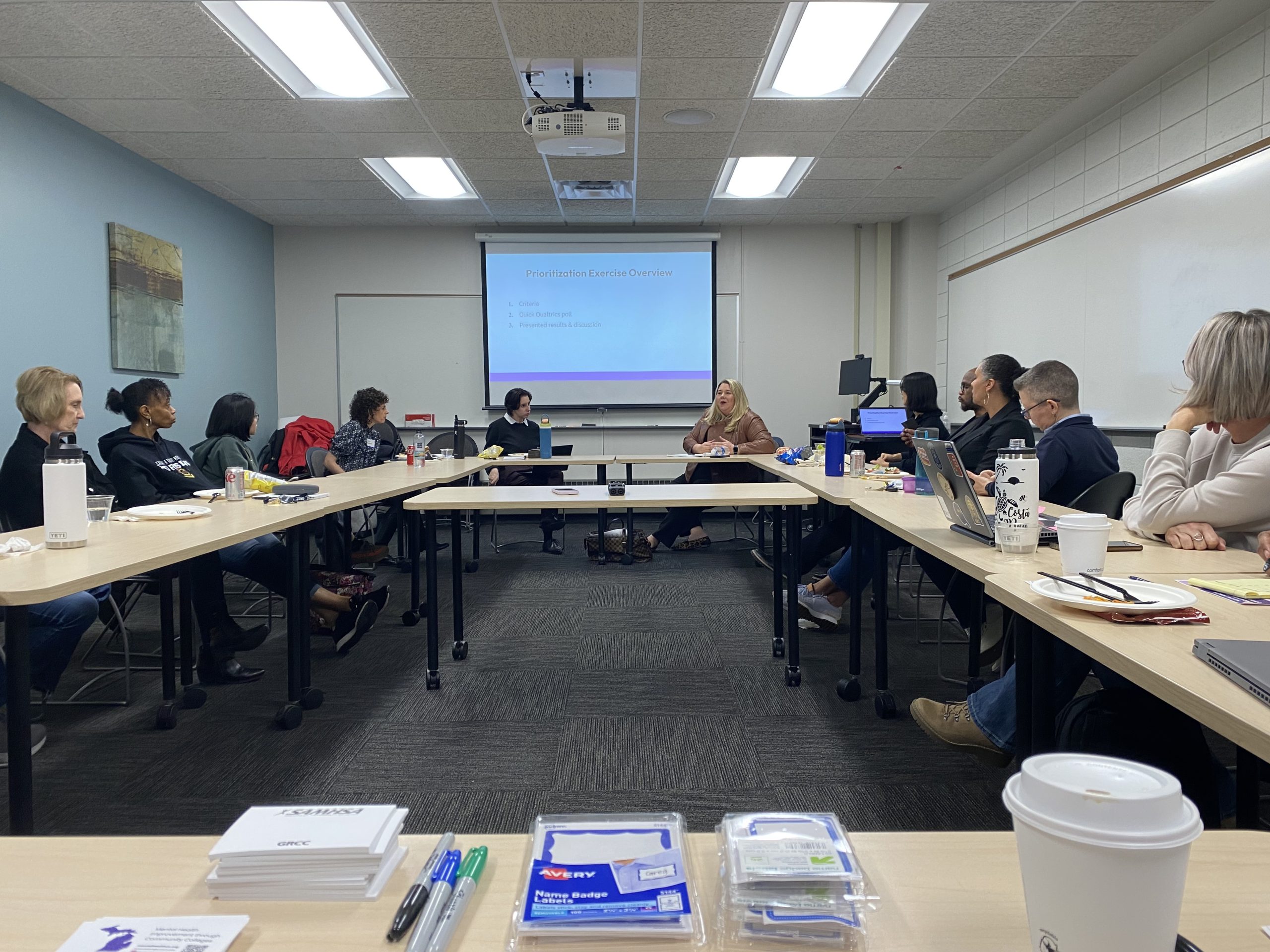
Months after a University of Michigan study found the Grand Rapids Community College and Career Development Center “falls below the internationally recognized standard for the profession and below the statewide community college average” client index load, the research team spent two days on campus last week to help assess the situation and begin an 18-month partnership to help make improvements.
Their goal is to enhance the treatment capacity for students at Michigan Community Colleges and partner with them to identify and prioritize needs in its mental services.
Principal Investigator Shawna Smith and her team met with 23 students, four providers, 22 faculty and six administrators on March 7 to better understand GRCC’s strengths and weaknesses and gather data for their Mental Health Improvement through Community Colleges report.
“…Some of the things we heard that you all are wrestling here is again number one, capacity,” said Sara Abelson, a co-investigator for this project when talking about the challenges at GRCC during the Rapid Analysis on March 8. “We heard that again, and again and again, we heard it so many different ways. It is important to name. It isn’t fair, it isn’t equitable, this is not the way it should be.”
With the 2024 Winter enrollment data, the CCD has a client index load of 4,594.8 students per provider, nearly 3 times the statewide average for community colleges. Ranking GRCC as one of the least-resourced centers in Michigan.
Abelson also explained another aspect that GRCC can improve on is the better-defined roles, with students stating they were confused when seeking out the college’s services.
“We heard that across teams, some clarity of ‘Oh success coaches do this and academic advisors do this and career counseling does this.’ And other times confusion from students, like ‘I don’t know where I go’ and ‘What if I show up here and my concern comes out this way, what happens to me then,’” explained Abelson after hearing the feedback of some students.
In February, the GRCC Board approved about $100,000 in funding for a new counseling position. There have also been talks about moving the counseling center into the Learning Center after it is renovated.
While it’s a step in the right direction, GRCC would need to have seven counselors to meet the state’s average client index load. CCD Director Melissa Ware explained that increasing capacity isn’t just increasing the number of providers but also working with outside agencies.
“There are many different ways. Yes, adding more counselors is one but that’s not the only approach,” Ware said. “What kind of community partnerships can we build?”
During the rapid analysis, MHICC Principal Investigator Smith asked the participants representing students and staff to rate the barriers to student access and identify the key issues with each. The barriers listed were language, availability, insurance, stigma, knowledge, technology and transportation.
Joel Reyes Hernandez, 31, is a sociology student here at GRCC. Hernandez explained that he was born and raised in the Dominican Republic before moving to the States in 2020.
Hernandez shared that he wished that GRCC had providers that could help more English as a second language (ESL) students. He stated that it’s easier for a student to use their native language rather than use a second language when talking with a provider. Language was identified as one of the barriers for GRCC students seeking services on campus during the meeting.
“There should be more people around campus that speak Spanish that can help students,” Hernandez said. “The language barrier is preventing students from starting here.”
Ware explained that she and the MHICC team will meet periodically to gather information for stakeholders and follow up with students and other groups they weren’t able to contact during that initial interview, Ware also hopes to build partnerships with community organizations.
“I think they’re (the MHICC team) still going to probably want to gather some more information from stakeholders,” Ware said. “I think they’re going to do some follow-ups with some people they didn’t get to. We will develop some shared goals and then work towards those. A lot of that is going to be building community partnerships and they’re going to help with that.”