By Shy’Ana Thomas
Last semester Grand Rapids Community College took 27 students on a day trip to Chicago where they got to take tours around the city and make memories while still learning. If traveling to Chicago for the summer. This trip the students took is a start of things to do and places to go around the city.
This trip started with students meeting in front of GRCC’s Ford Fieldhouse at 6:30 a.m. to take attendance and pick their spot on the bus. Following that, the staff introduced themselves,since they would be breaking into small groups once they arrived in Chicago. This trip was a two-and-a-half-hour drive from both destinations, and students were given an English Department notebook and pen to write down things they saw and learned while away.
First stop: American Writers Museum and The Bean
While those couple of hours flew by, the students arrived about 15 minutes earlier than expected, getting off the bus at around 9:25 a.m., and broke into groups. Now students were standing on Michigan Street, where students would walk up a hill to the golden doors of the museum where students were heading to. The American Writers Museum was across the street from the South African restaurant “Nando’s”and so many other food spots.
Students walked into the huge museum and were greeted by some of the staff. After taking the golden door elevators with our group, students finally met our tour guide, who was a Grand Rapids native. They showed us where the gift shop was located and showed us a video that went into detail about all the other sections of the museum students could all explore. There were so many things to look at and take pictures of, such as newspaper articles of Emmet Till and articles about our first Black president and the first lady. They had a display dedicated to “The Black Press” that documented how the Black press fought oppression through the first Black newspaper and the “Freedom Journal,” which had a safe space for Black voices and journalists around that time. Also, shining a light on the other publications run by Black people that came after the Freedom Journal.
Another fascinating thing was the magazines, books and novels written by American-based authors— some born in Chicago, some who migrated to Chicago and writers from New York and beyond. They also had displays of Langston Hughes’ books, such as “The Dream Keeper and Other Poems,” to books by Lorraine Hansberry and “The Bell Jar” by Sylvia Plath.
This museum showcased diversity through displays of the first magazines. There were books everywhere which included the rainbow book ceiling of different novels, to childhood favorite books such as “Charlotte’s Web” and “Where the Wild Things Are”. The gift shop kept shirts, books and black and white postcards of the writers.
After leaving the American Writers Museum, we walked one block to eat lunch in front of Chicago’s famous attraction, “The Bean,” and see all the other community colleges and people dressed in costumes for a convention while we ate.
Second stop: The DuSable Black History Museum and Education
After passing by Oakland, a Chicago community area that had a big “Black Is Beautiful” sign, students made it to the second destination. The DuSable Black History Museum and Edition was a museum that was dedicated to not only Chicago’s Black history, but, Black history from decades and different states. Walking to the doors, students and staff saw the University of Chicago next to it, with so many college students around the campus and museums. We were handed a small magazine that contained information about Martin Luther King Jr., and a booklet of the museum and other locations to go to in Chicago.
The museum’s first part contained photos of MLK, his wife, Coretta Scott King and African American activist James Baldwin during their march in Chicago. Nearby were art pieces and masks by a variety of different African artists. We then saw two walls full of the history of Black people in World War II and the Spanish War and saw the uniforms and helmets that they wore.
Moving on, students saw walls filled with photos and “Vote” pins from Chicago’s first black Mayor, Harold Washington, who was elected in 1983 and re-elected in 1987, dying that year during his second term. Entering the room, there was a life-size animatronic of Washington that told the story of his time in Chicago and the things he achieved.
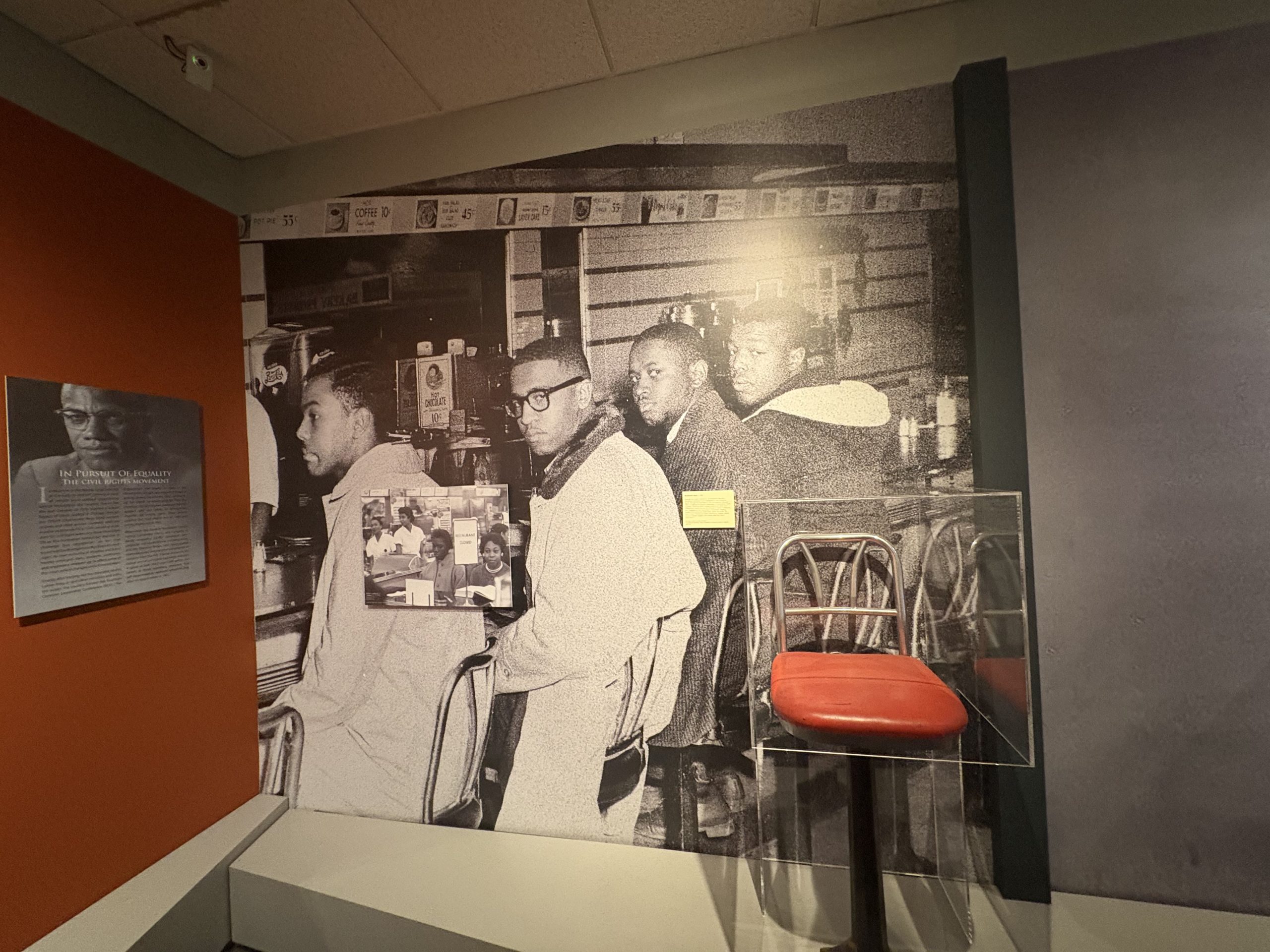
The next room was dedicated to the history of slavery in Africa, and then branched into the segregation era. Talking about the restaurant sit-ins that young African Americans would do to protest, and then the “I AM A MAN” protest that went from February to April of 1968, where other Black civil rights leaders showed up for the Black sanitation workers stemming from Memphis. They had displays dedicated to Emmet Till, The Black Panther party, Brown vs. Board of Education, Fred Hampton and the history of White supremacy.
Following the newly added exhibit that goes into Black Women’s history called “I Am Her,” an introduction video was played depicting the history of Black Women during slavery and Black Women who died at the hands of the police. There were paintings of Breonna Taylor and Sandra Bland, who are two women who were killed by the police.
Lastly, while being at the “I Am Her” exhibit, students could hear loud and passionate singing coming from a backroom, which led to a theater where Paul Haul was practicing with his band “Verzatile” and other local Chicago musicians for their tribute “A Night With The Queen” for Aretha Franklin. The show was scheduled for April 13. Tickets were originally sold for $40, but everyone on the trip got to watch a free practice performance with some of the singers involved sitting with us.
When leaving the museum everything the students saw came to an end. It left some people on the trip emotional because of all the things students learned and took in.
Last stop: Hyde Park Neighborhood
The last stop of the trip was to take a walk through Hyde Park, which is on the South Side of Chicago, with a lot of diversity of Black and Latino people as you walk through. We walked where all the college housing was located, as a college party was held down the opposite street, seeing so many students walking to it. Students got to talk with Chicago natives while also getting the chance to sightsee. While walking, students saw parks full of children since the weather was so nice, and also saw the houses on the streets that looked like those houses in the wealthy areas back in Grand Rapids.
Groups were told to split up and walk around from the museum to Hyde Park until everyone got to their assigned restaurants. While walking, students got to see where Barack and Michelle Obama had their first date and kiss, in front of what used to be Baskin-Robbins. After seeing so many good food spots and people selling things on the street, students and staff finally made it to the area where all the reserved restaurants were. A group of students spotted a Black-owned bakery called Struggle Beard Bakery, where later students planned to stop before heading back to Michigan.
The restaurant that students in group four were assigned to was a Jamaican/Caribbean style restaurant called Ja’ Grill Hyde Park. The restaurant was vibrant and full of pictures of Jamaican legend Bob Marley and reggae music, which is a music genre originating from Jamaica, played all through the restaurant while restaurant regulars came for their same drinks at the bar. Students all tried different dishes ranging from Jamaican-style curry chicken to Jamaican jerk beef ribs, with every meal coming with three sides of Rice and peas, Plantains and cabbage with carrots. Students had so many different drinks to choose from, such as a Ting and Ginger Beer. The workers and owners were so nice while serving such a large table of people. The food was amazing, and I would go back and recommend it to others.
After eating our meal, students finally headed to the Struggle Beard Bakery, owned by Quinton McNair, who greeted all the students outside before helping us with students purchases. Walking in, the smell of desserts before students could even see the vibrant-colored desserts and flavors they wanted to taste. McNair is a retired U.S. Army veteran who struggled with PTSD (Post Traumatic Stress Disorder) and depression. He said opening the Chicago-based bakery helped him get through that rough patch. He greeted everyone with a smile and even offered discounts for all college students on Tuesdays. He helps you make your coffees and lattes to perfection and just how you like.
With the clock striking 7 p.m., students and staff boarded the bus at a Trader Joe’s to get prepared to go back to Grand Rapids, as everyone carried their leftovers and desserts back to the bus.
Professor Muhammad, who helped make this trip for students possible, shared her thoughts on what this trip was all about.
“When people hear ‘study abroad,’ they usually think of flying overseas and using a passport. But for many community college students, global learning can start much closer to home,” Muhammad said. “That’s why I designed this one-day trip to Chicago as a ‘mini-study away’ experience—to help students explore new places, get curious, and build confidence to travel farther in the future.”
Muhammad also talked about how she and her family created a scholarship.
“To break down those barriers, my family created the BHMS (Bachelor of Homeopathic Medicine and Surgery) Intercultural Scholarship to help students cover travel costs. I’ve proposed study abroad programs to places like Jamaica and Barbados—destinations full of history, culture, and learning opportunities for everyone. I organized this Chicago trip to allow students to try something new without leaving the country, helping reduce some of that fear of the unknown,” she said.
Muhammad said community college students deserve the opportunity to go to these places and see more of the world to learn.
“Community college students belong in global learning spaces, and I am committed to making that possible,” she said. “This trip was one step toward urging community college students to imagine themselves as part of the world and realize that when they participate in learning that takes them beyond the classroom, beyond their cities, and their comfort zones. They’re not just part of the world—they are the change the world needs.”
This trip was such a fun learning experience to be a part of. Seeing different people and being in these inspiring places was such an amazing opportunity as a college student, and I hope GRCC gives out more opportunities so more students can continue to explore.