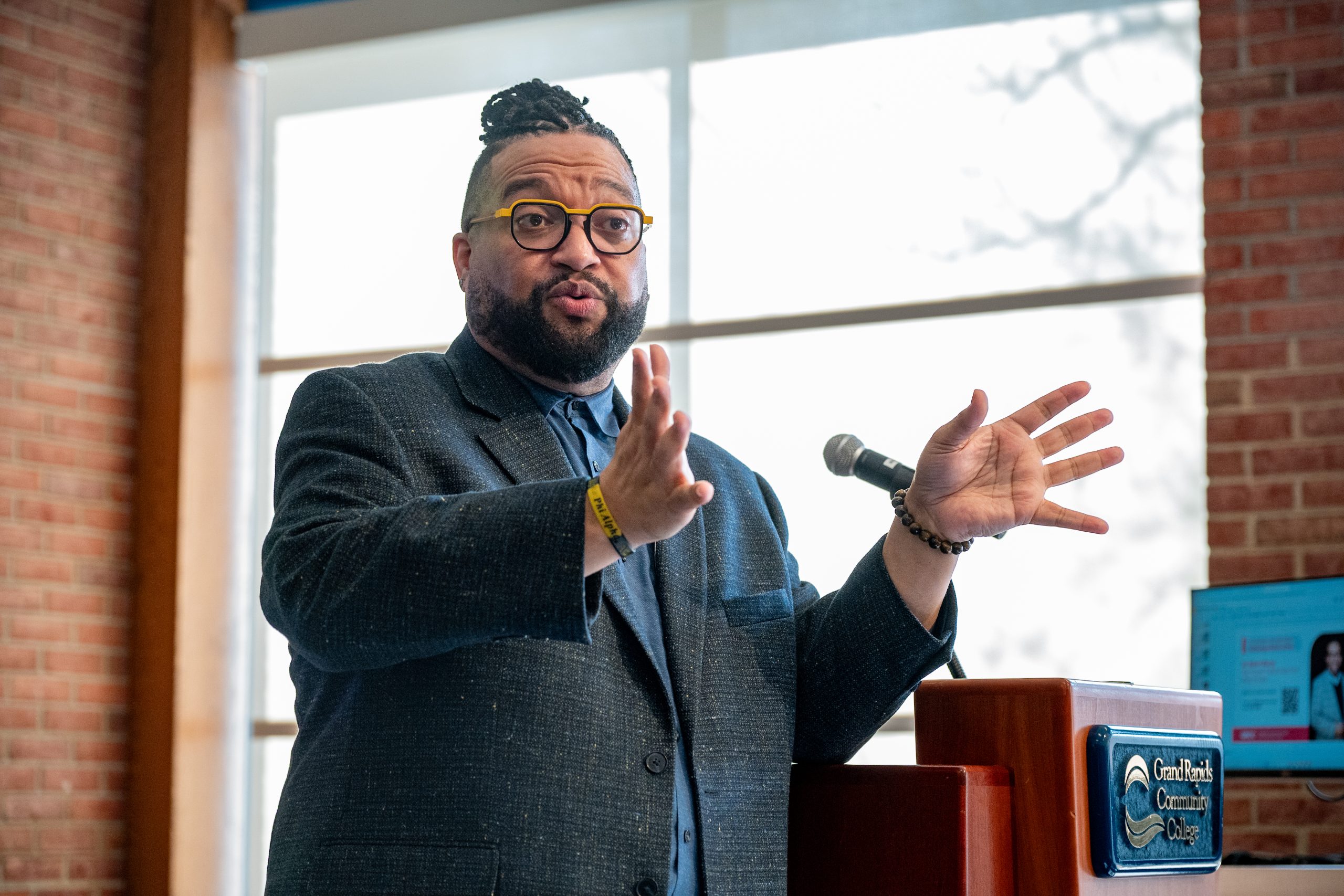
Every seat was filled inside Sneden Hall Room 108 at Grand Rapids Community College on Thursday morning as students, faculty, and staff gathered for a lecture hosted by the Bob and Alecia Woodrick Center for Equity and Inclusion.
Rob Shorty, vice president for People, Equity, and Culture at Grand Valley State University, delivered the talk, “Stay Focused: Radical Hope Even When It’s Hard”, urging attendees to treat hope not as optimism, but as deliberate action.
Shorty opened by asking the audience to take a collective breath together. He then shared a story about a forest fire and a hummingbird, a hummingbird that carried drops of water to the flames while larger animals stood by. The sentiment, “individuals may feel small in the face of systemic problems, but small consistent actions matter,” served as a framework for the lecture and the personal experiences woven in.
“Hope is not a feeling,” Shorty said. “It’s a verb.”
Throughout the lecture, he described the current social and political climate as one that can feel overwhelming, particularly for marginalized communities facing what he characterized as historical erasure and intentional discouragement. Waiting to feel hopeful before acting, he said, often leads to paralysis.
“Despair is the goal of the oppressor,” he told the audience. “If you wait to feel hopeful before you act, you will stay frozen.”
Shorty framed “radical hope” as an everyday discipline, that is, building relationships across differences, continuing to act even when outcomes seem uncertain, as well as cultivating a culture of care where we “care for our history, care for our truth, and care for each other,” as Shorty said. He pointed to historical examples of collective action, referencing the Great Migration and lesser-known civil rights figures such as Claudette Colvin and Charlotte Forten Grimké, to illustrate how change often comes from ordinary people.
At the end of the lecture, everyone was invited to stand and find a partner. Shorty started,
“Repeat after me: I am because you are. You are because I am. When I thrive, you thrive. When you thrive, I thrive. When I fail, you fail. When you fail, I fail. I recognize the creator in you. I hope you see the creator in me. I am because you are. You are because I am. I love you because I am you. I love you because I am you. I LOVE you because I am you. That is your focus, GRCC.”
Shorty offered a question-and-answer session at the end of the lecture, where students and staff asked him to expand on the personal and practical roots of his message.
Steven Triezenberg, interim president of GRCC, asked, “Would you be willing to tell us about one or two of the hummingbirds that brought a drop of water into your life?”
“You’re a teenager,” Shorty said. “Your mom’s telling you you’ve got to go live somewhere else because she just can’t do it anymore. At the time, it felt awfully lonely and felt horrible. But looking back, that was my hummingbird. That opportunity gave me access to things that my mom could not provide for me at that time. And with access, it breeds new expectation.”
He explained how exposure to new environments helped him imagine possibilities he hadn’t previously considered.
“It’s hard to want something that you don’t see,” he said. “I didn’t grow up around people who went to college or had careers like the one I have today. How do you frame your mind to go after that which you don’t see on a day-to-day basis?”
Shorty added that many other “hummingbirds” were mentors and adults whose advice only made sense years later. “Those were seeds that they planted that grew fruit later,” he said.
Another attendee, GRCC student Anastasia Parm, asked how long he had been spreading the message of radical hope and “making the community not only here but like everywhere aware of it.”
“I’m kind of a glass-half-full,” he said. “I’ll sit in the hard stuff for a little bit, but I’m not a person who can sit there for a long time. I’ve got to say, ‘Okay, what’s the plan? How do I change it? How do I impact it? How do I turn it?’”
Jamillya Hardley, Director of the Woodrick Center of Inclusion and Multicultural Affairs, asked Shorty to speak to “alignment and identity … for folks who might be still trying to figure out who they are, especially in a time where people are trying to erase their history, erase who they are, show up in spaces where they’re not necessarily invited to or belong to.”
Shorty responded that the foundation for purpose begins with self-worth rather than achievement.
“When you sit in the margins, whatever that margin is, you sometimes feel like you have to prove something just to show up,” he said. “But it’s not about anything that you can do that’s going to lead you to a place where you feel present, seen, heard, and valued. You have to believe you already have that.”
Shorty’s sentiment was clear: large-scale change begins with small, intentional acts carried out consistently by individuals who refuse to give up.
For those unable to attend in person, a livestream will be available to view until March 14, found here.