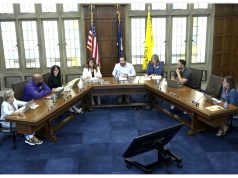
Grand Rapids Community College’s 11th President, Charles Lepper sat down with The Collegiate staff for a question and answer style interview March 23. Topics of discussion included mental health, LQBTQ+ rights and school safety. This interview transcript has been edited and condensed for clarity and length .
Since you started here about eight weeks ago, how have things been going?
Well, a lot of my time has been meeting with folks… hearing from them what’s working well, what we need to continue doing, what we need to build upon, what are some things we need to stop doing or improve, and asking them how do I be successful at GRCC.
Coming from the outside into an institution that you all know better than I do at this point, and what advice do they have for me. So I had one with a group of faculty and one with a group of staff. I had a “Lunch with Lepper,” and heard from students last week as well. So I’m just trying to get out and meet folks, and understand the institution, our processes, who we are or how we work, and building relationships, like I said during the interview process, that’s what I would spend a lot of my time initially doing. I’ve been also out in the community doing that as well, meeting. Business and industry leaders and local, elected officials, having conversations with them, as well as with our K-12 partners and, and other, and our four year institution partners.
What have you learned about GRCC so far? What kind of priorities are you focusing on right now?
Well, I’ve learned a lot. Every day seems like every hour I learn something new, even if it’s just, you know, what this abbreviation means. So sometimes those very simple things. What I have, I won’t say necessarily learned, but what I think has been reinforced for me time and time again, is that we do really good things here. I believe that we have really good students here. I think we have really good faculty and staff here, and there’s so many times that that’s been reinforced for me.
We have some things that we need to work on. I think some of the conversations around equity and inclusion and a sense of belonging is one of the things that we need to continue to work on. Certainly we need to think about how we build our enrollment. As you all know, our enrollment is down. Most community colleges around the country, it’s a rarity that a two-year institution is not down in enrollment. Community colleges have really been in a decline in enrollment since 2011.
That’s mostly true for us as well too. It’s not uncommon. So we’ve gotta figure out how we stabilize our enrollment and hopefully regrow that enrollment. And that’s some of the conversations I’ve been having out in the community… Right now our number of our residents who have post-high school credentials or certificates, we’re ninth in the state. We wanna be number one.
So how do we get there? We have some pretty unique opportunities right now with Michigan Reconnect with the Michigan Achievement Scholarship. As you may know, we as an institution give away about $1.3 million annually in scholarships through money that we raise as an institution. So there’s a lot of resources and support to help students financially, but we also need to figure out how we support students with some of those, what I would call other needs like childcare, home security, food security, transportation, that is a piece of that pie as well, or a piece of that puzzle I should say.
As well in helping students be successful, I believe wholeheartedly that our students come to us wanting to succeed, wanting to complete but I think life gets in the way and it often makes it complicated or difficult or impossible, for sometimes our students to complete. And so we’ve really gotta focus on removing those barriers to completion.
What are some of those specific challenges and how are you specifically focusing on meeting those challenges and helping people with retention?
Well, I think certainly one of the things that we have the most control over as an institution is tuition. We have affordable tuition. Particularly when you layer on if you have Michigan Reconnect or Promise Zone. Our eligibility, our costs are actually less than what a student would receive in those programs. And so we have made a commitment as an institution a long time ago, and we did it again this year, was to keep our tuition as low as possible.
You know, inflation is out of control in this country. We all experience it every day, and we made a commitment this year to keep our tuition increases as low as possible. We increased tuition by $2. Which was about a 1.7% increase. When you think about the other inflation effects on prices that are closer to 8%, 10%, we experience those too as an institution.
So as all of our personal costs have gone up, our cost as an institution has gone up too, because we have to buy many of the same things. You know, our utilities go up, cost of our staffing goes up, the cost of our healthcare goes up, our cost of food goes up in our auxiliary services. We feel those impacts too. So we’ve been really trying to manage those really aggressively so that we don’t have to pass that cost along to our students because you all are getting hit with it in your personal lives as well too. So that’s the thing that we’ve really been tackling this year.
How do you balance financial obligation with quality education? Do you have a philosophy on that?
Well, I think they can be hand in hand. I don’t know that there’s a particular philosophy, but I think we have to ask the question of is what we’re doing makes sense and does it benefit our students? And that really serves as our guide of what impact does it have, and what is our return on investment?
We’re mindful every day of how we spend the dollars that come into the institution that comes out of your pockets, and also out of our community’s pockets. And so we have an obligation to be responsible and to be good stewards. And so I think we ask questions every day about how does this benefit the educational experience of students. How does it help support them to be successful before we spend money…
What has your 25 years of leadership experience both at four-year and two-year universities taught you and what strengths do you bring to GRCC?
I was the first one in my family to go to college. I went to college thinking I would fail. I started in developmental math classes, and I really didn’t think I would be successful. It was because of an individual at the university I attended that got me engaged, got me involved as a student, who helped find that spark in me and that confidence in me that I initially lacked. That went from being a freshman to being engaged in student government and student clubs and organizations. I started, if you’re familiar with resident assistants, there are students who live on the floors of dormitories who kind of help other students. I did that for three years as an undergrad. That really led to the pathway into higher education. I’ve always worked in higher education except for the summers I was in college or in high school, but I learned so much, I look back and I never dreamed I would get to do the things I have gotten to do. That was never within my thought process, So, that’s really hard for me to say that there’s a list of specific things that I have learned.
I’d say at the root of that, I’ve learned that relationships matter most. I think I knew that then but maybe not to the extent that I know and recognize today. You have to have relationships to be successful in anything and it’s those relationships that really get you through any difficulties or having some of those difficult conversations. I’m sure you’ve heard the old saying of ‘When you realize you need a relationship with someone it’s probably too late.’ So I try to spend time on building those relationships because I believe that leads to collaboration, that leads to trust, that leads to dialogue, that leads to positive feedback, and ultimately leads to a better place.
You’ve mentioned in the past that your assistant principal in high school said that you were unfit for college, and now you are running one. What would you like to say to students who have a similar story?
Don’t listen to those folks who say you can’t. Know that you can. I don’t believe that community college is a second chance, I think they are the smart choice. I grew up in a state that did not have a community college when I was a student, I grew up in Indiana. I think that the benefits of community college in your first two years are far better than what I got out of a large four-year university. I was never in a class this size where I got to know my faculty member and I got to know my classmates. I was in much larger classes. There were no classes that had less than 30, and some were 300 people. I think from a cost perspective, and from a learning perspective, and being able to interact with your peers and faculty, community colleges are the smart choice… I would love for our higher ed system in this country to change so that became the model… I think that there’s so much value and benefit to the learning and the learning environment that we have at community colleges.
The Lakeshore tuition rate is about double the cost of in-district tuition, do you have a plan to make out-of-district tuition more affordable?
I don’t have a plan, and the reason why I say that very clearly is because it is not up to the college to decide… It’s really based on school districts and alignments and the citizens vote on whether a portion of their property taxes go to support the community college or not. For Kent County, that’s KISD (Kent Intermediate School District), and that is why folks who live out at Lakeshore and outside KISD pay out of district. There are some conversations in those communities about proposing a referendum, but by statute in the state, we have to remain neutral in that as a college we can provide them with information and data, but we can’t go out and actively campaign for that. It’s been a conversation that has been ongoing for 20 years that hasn’t come to fruition so it’s not up to us, or up to me to make those decisions. It’s up to the communities and the citizens that live in those districts to do that.
What made you specifically want to be the president here at GRCC as opposed to somewhere else in the country?
I think a number of things specifically about GRCC really checked many boxes for me when I applied. I will make it no secret that there had been other places that I had applied to be president too. It’s rare that you are offered a position as president at an institution the first time you apply for it. It’s a pretty rigorous process and it should be. What made GRCC special to me was, I kind of knew GRCC a little bit. As you know or may not know, I attended graduate school and earned my master’s at Grand Valley State University 25 years ago, and so my master’s is in higher education administration as well as my doctorate, so I had some familiarity. I’ve had friends who worked through here. I have connections, and have still maintained friendships in the community and know people who graduated from this institution. So I knew a lot about GRCC in comparison to other places. I also spent a lot of time looking at our website. One of the things that I love that we do as a community is that we have the Promise Zone, which I’m very focused on, access and affordability. And so to have that as a benefit to individuals who graduate within the Kent Intermediate Schools District boundaries, to be able to come here, that’s a huge opportunity.
Education levels all playing fields. And so from an equity perspective too, having that resource means that there’s a commitment to all those things for citizens of Kent County. How can you not get excited about things like that? There’s lots of good things going on here. Also I would say to you as students, you should be very proud and feel good about the institution you’re attending. GRCC is known nationally and has a national reputation among community colleges, and so as I made my way through the interview process, I had former colleagues reach out to me and say, ‘That’s a really good school’…
What is your plan for the future of the Office of Diversity, Equity and Inclusion?
Well, first and foremost, I would say we have to be focused on the future. I know that there have been some things and The Collegiate has covered some of the things in the past. That was before my time here. So I’m forward thinking and we have to be forward thinking and look ahead.
So what I have asked happen and what is happening is I have asked three of our faculty, staff members, Dr. Kate Kryger, Lina Blair and Sophia Brewer… to lead conversations about what equity means at GRCC. What is our definition of it? What is the role and the goal of the Office of Diversity, Equity and Inclusion?
And one of the things I’ve also asked them to embed in those conversations is, should there also be a B on the end of that for belonging? And so, diversity, equity, inclusion, belonging, because we should feel a sense of belonging to the places that we live and work and learn.
And what we’re going to do from that is there’s gonna be a number of forums that they’ll be hosting. There’ll be some for faculty, there’ll be some for staff, there’ll be some for students, there’ll be some for community, and there’ll be some general ones that anyone can come. And they will be summarizing the forums for me and making recommendations based upon that and then what we’ll do is from that feedback is rewrite the job description for the executive director of that office and do a national search. So there has to be alignment between what we want and what that person is asked to do.
What do you think our Office of Diversity, Equity and Inclusion should be focusing on?
Well, I think it goes beyond students. I think it includes all of us that are part of this community because none of us are all knowing. We all bring our own experiences, identities and perspectives to those conversations. I think what I would say is it has to be educational in nature and be inclusive of all voices. It can’t just be the ones that we agree with or that I agree with. Because that’s part of that inclusiveness and that diversity of thought, diversity of opinion, diversity of belief, diversity of values. There is enough space for all those. And if it’s done in a respectful way, that can really enrich our lives from a learning perspective, from a work perspective… You’re the future leaders of this community. And so we have an opportunity to really role model how to do that in a respectful way that happens beyond here too, because that’s the way it should be.
It doesn’t necessarily mean everybody has to agree or there has to be consensus, but I think that is part of that whole process of learning and and part of what I would hope is that we can say, here are the things that we eventually get to a point that says, here are the things that we’re doing over the course of a year, and we can kind of map that out a year in advance and then what I hope that does is it also allows that to be incorporated in some of the classes that we have as part of the discussion, part of the materials, part of the reading, to really engage that entire process from a learning perspective and from an experience perspective. And that’s where I hope we eventually get to. But it’s not about what my vision is for that, it’s about what our collective vision is. I’m one voice in that conversation, but I’m just one voice in that conversation.
Do you intend to increase the awareness of GRCC sports teams and their accomplishments?
I think athletics does enrich that environment for our students. I think our student athletes have tremendously complicated lives, and I know they balance a lot. They’re often required to be full-time students, they travel, they have practices. They have just as complicated lives as non-student athletes who work or who have family responsibilities. I also know that data for student athletes often is, they often have higher GPAs, often have higher completion and transfer rates, but it’s again, because of that team experience that they have.
I think what I would like to see is us expand into recreation sports. So not necessarily competitive NJCAA sports but, do we have things like three on three basketball? Do we have soccer? Do we have those kinds of those intramural sports? But that’s an assumption that I would think students would want to have, but we don’t know, I don’t know if we’ve ever done any type of survey or have any data from students if that’s something students would want. There’s also esports where some institutions have hundreds, if not thousands of students engaged in esports. And I think those are all things that we have to talk through and talk about.
With all of this anti-trans legislation coming through in other states regarding schools, if that comes our way, do you have any plans to protect the rights of queer identifying students here? And do you have any message to queer-identifying students?
First, I would say as an institution, but also as the president of this college, I see you, I value you, you belong here. And so that’s the first thing I would say. The second thing is a harder question to answer because there’s many moving parts to that. I’m sure you have seen the coverage on that in the media. There are some states who are taking very different stances than Michigan. I know that the Elliott-Larson law was just signed by Governor Whitmer… I hope that serves as the protection that members of those communities need, to be in a safe place physically, emotionally, and can thrive… It’s a complicated circumstance, but I will do everything that I can to make sure that this is a safe place for every student, and that may mean we have to have some difficult conversations. That may mean we have to make some tough decisions. That may mean I need to advocate in different ways than I do for our students now. But this place should be a safe place, safe and welcoming place for everyone. And as long as I have the ability to do that, I will do that.
The national standard of counselors to students is 1 counselor per 1,000 students. However, GRCC is about four times over that rate. Do you have plans to improve our counseling department or even get the number of counselors up?
What I can tell you today, eight weeks into the position, mental health is an important topic. I will tell you where I come from, the Intermountain West. So I come from Salt Lake City, I’m not from there, but that’s where I most recently came from. It has among some of the highest depression and suicide rates and suicidal ideology in the nation. So I’m well aware of the challenges with mental health in this country and the stressors that students experience, and I would say we all have been through a traumatic experience with COVID… Part of what I did personally was I went through Florida State University and I completed a certificate in trauma and resiliency to better understand those issues. That’s part of how I spent my time in lockdown, with learning.
It really is a resource issue and I don’t know the data specifically for some of these points in Michigan, but as an institution we need to identify or find resources or find ways to have the resources, I think, to hire more counselors. It doesn’t necessarily have to be, what I would call professional license counselors. There’s some research that indicates that there’s other successful models out there. There are some models that engage peer advisors for some basic counseling needs… It’s something we really have to dig into. In many parts of the country, there’s also a lack of mental health professionals. There’s companies that help do that, there’s training that helps do that. It’s something we really have to dig into. It’s just not something you flip a switch and say we’re doing this, that’s also beneficial to students. But also in many parts of the country, there’s also a lack of mental health professionals. And so it’s just not about the ability to pay for them, but there’s also a lack of availability because those are stressful jobs too. Imagine hearing folks’ stressful situations and challenges all day every day. That is a lot to take on.
So some people aren’t going into those professions like they used to and so there’s a couple challenges along with that, but I do know that ratio of about a thousand to one… I think within that, we also have to make sure our counselors are representative of the students that we serve. Some of those things include gender, gender identity, sexual orientation, race and racial and ethnic background, multilingual. When you really start to do that with intentionality, that even becomes harder because it’s harder to find folks who meet those identities as well and you can’t hire people based upon identities. You have to hire the person who’s best for the job and hope that you are getting a diverse representation of counselors that reflect the communities that you’re serving.
What is your plan to improve campus safety here at GRCC?
We are having conversations on how we can maintain a safe environment here and one of the things I would say is that it takes all of us. One of the things I worry about is that we come to these spaces everyday and we start to feel comfortable and we let our guard down a little but and we think somebody should be looking out for us. We all have to look out for each other and that’s the best system we can ever put into place because we can’t create a police state, we are a public institution. But there are other things that we can do and some of the things we have already done as an institution is that every one of the classroom doors locks. Not all colleges and universities have that or can do that. We have telephones in all of the classrooms that has a button that says police and so anybody can pick up the phone and hit that button that goes to our dispatch and they know where that call’s coming from.
We also have what’s called the big red button. From our dispatch station we can lock and unlock exterior doors to our buildings…. We also have emergency call boxes on campus so that if you are in a place where you feel unsafe, you can hit a button and the police will know you’re there too, and you can talk to dispatch and I believe they have strobe lights on them as well so it draws attention and that hey, something not good is happening here. We also have the RAVE system.
That doesn’t mean we can’t improve. One of the things we’ve done is we had an agency come in and provide us some feedback although it wasn’t as in-depth as we had hoped. We shared in one (safety) forum that the Department of Homeland Security were actually scheduled to be here the day after the incident occurred at Michigan State, so that got rescheduled because they were deployed to Michigan State to assist with that situation there, that tragedy. We have since completed that audit and we have some high level recommendations as kind of a first level review, so there’s a group of folks who are going through the recommendations. I am meeting with the chief of police and also Lisa Frieburger, who is our Vice President for administration and finance, who supervised that area of the college to say what do we do with these recommendations and how do we do this better if we can and if we need to.