By Grace Holmes
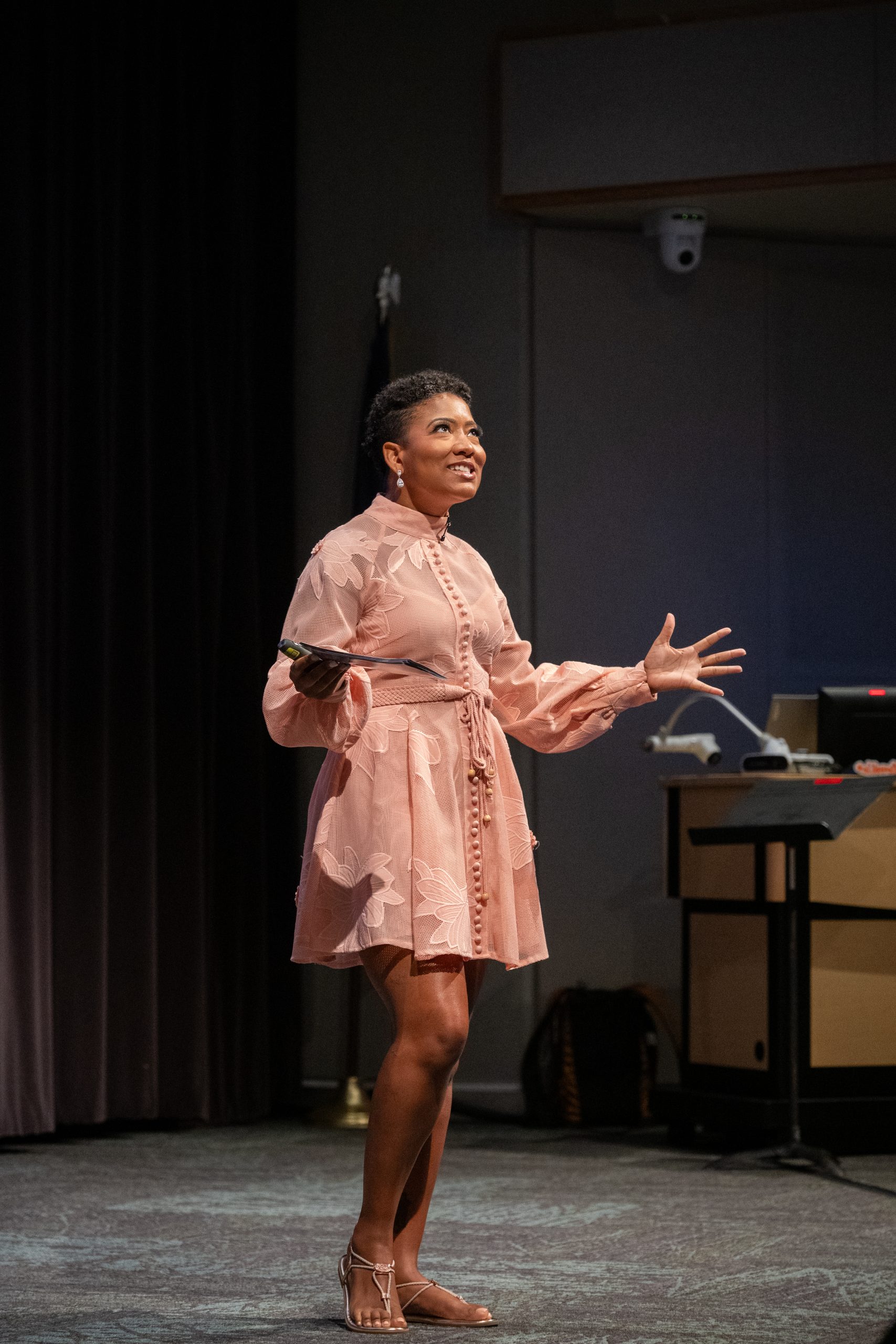
On Sept. 18, Dr. Brandi Pritchett-Johnson spoke about how to appreciate everyday life struggles for Grand Rapids Community College’s 31st Annual Diversity Lecture Series. During her presentation titled Leading With Heart, she focused on how to use moments of anguish as fuel, rather than a reason to give up. Pritchett-Johnson detailed the importance of becoming a better version of yourself to better serve your community.
In addition to being a licensed psychologist, therapeutic coach and speaker, Pritchett-Johnson is the creator and CEO of the Diane Morgan Group. Beyond titles of professionalism, though, she is a self-proclaimed visionary and manifester with big dreams. Pritchett-Johnson mentioned how one day she would like to have a building of her own to train young individuals who want to be involved in mental health.
During the lecture, Pritchett-Johnson asked everyone to raise their hand if they were familiar with the human sentiment: it is what it is. Not only did every hand in the room go up in a chorus of confession, everyone helped complete the mantra. Pritchett-Johnson then revealed that, despite how common the phrase was, it is actually a sign of apathy. “We are all carrying symptoms of angst,” she said. Stress and struggle are inevitable. None of us can avoid it.
Oftentimes, feelings of angst can be as simple and universal as questioning one’s purpose in life. It can be easy to feel discouraged and to wonder if any amount of effort will lead to success. Pritchett-Johnson admitted, “My fantasies have been persistently interrupted by trials, tribulations, and tragedy.” In spite of these setbacks, though, she has remained hopeful for her future endeavors.
People may feel they are failing if they are experiencing setbacks, but that is just the human experience. Life can be challenging and intimidating, but it can also be dynamic. We cannot always control what we experience, but we have the privilege to learn from those moments.
“No matter what I’ve been through, I can hack it, I can utilize it, I can adapt it, I can transcend it, I can use it,” Pritchett-Johnson said.
The ability to “hack” apathetic moments is a theoretical approach called post-traumatic growth. Pritchett-Johnson expanded further on the concept and said that through the utility of trauma, people can learn to become better and ultimately make life worth living.
Getting ready is one of the most significant stages during the process of getting better. Pritchett-Johnson said, “This is where the magic starts to take form.” This is when the vision finally begins to form, when the anticipation starts to look like a future. While people tend to skip this stage, it’s one that is beneficial. It’s beneficial because it is when a person realizes that their magic is truly enough.
“You need nothing more than what you already have,” Pritchett-Johnson said.
Part of growth and becoming better is understanding that everyone must put the work in themselves. People must reach from within. To reach that magic that is already in them and to allow themselves to be better.
While it is easy to stay stagnant, to accept a life that is unfulfilling, those habits can also be unlearned. “To be liberated, I must get better. I must get better,” Pritchett-Johnson repeated.
Being liberated means being able to live freely and to the fullest extent. A way to achieve this is through vision. A person must envision a life they desire to be a part of. This does not mean what job a person may hold, though, which is an assumption that stems from the questions asked during adolescence. Rather than focus on occupation, they must think about what they desire to experience.
“Who we want to be, how we want to contribute, are the most viable questions of the day as opposed to what exactly we want to do,” Pritchett-Johnson said.
In a society that demands speed and performance, it can be difficult to think purely on desires, but the answer is one that will lead to liberation. By figuring out who rather than what, a person is able to transform into a better person themselves and thus live free, Pritchett-Johnson said.
Getting better in itself is not a new concept, but one that is still a prevalent goal.
Despite what culture has made us believe, doing better does not mean doing more. Rather than quantity, we should be focused on quality.
“Perfectionism is not the goal,” Pritchett-Johnson said.
Many people think that in order to experience a change in their behavior or habits, they must constantly be moving in an upward direction, but it’s just the conscious act of putting in effort that is important. After the lecture, an audience member advocated her opinion of unlearning habits and the right time to make a change. Danielle Gregory, the Associate Vice President for Diversity and Inclusion at Western Michigan University added that she’s “already been looking to make changes right now,” and “realizing that this stage is not a stage to fear, to dread or to procrastinate in, but to use it as a strategy to mobilize.”
Pritchett-Johnson relished in the African philosophy of Ubuntu, which emphasizes community and the interconnectedness people share. The beauty of Ubuntu is further exemplified as she said, “I am significantly impacted by something as simple as the glimmer in your eyes. That’s how magical you are.”
Together, we all have the opportunity and responsibility to create a community that encourages health and wealth. We all have a desire to be better, to do better, to be better for others. To be better is to be liberated. To achieve this universal goal, Pritchett-Johnson told the audience “to ignite the fire and the passion that’s already in you, to go and use your magic.”